


When to Switch to a Toddler Bed
July 31, 2026
Jordyn Koveleski Gorman

Last Updated on July 31, 2026 by Jordyn Koveleski Gorman
This page contains affiliate links. We will receive a commission on qualifying purchases using these links.
The right time to switch to a toddler bed is different for every family. There are so many factors that can go into making this decision! And a quick glance at social media will have parents convinced that they’re behind if their 8 month old is still in their crib (hint: you’re not).
Deciding when to make the switch to a toddler bed, whether that’s a floor bed, twin, crib-sized mattress, or even a larger bed that grows with your little one, depends on several things. Your little one’s safety, family bedtime routines, challenges with current sleep scenarios, and even your family’s values can impact when it’s time to make this change. Understanding your toddler’s development and their readiness is also a key factor.
Let’s talk about some things to consider when making the decision to graduate to the toddler bed, through the lens of your little one’s development.

Safety reasons to switch to a toddler bed
There is no specific age requirement for transitioning out of the crib into a “big kid” bed. Generally, the longer you can safely wait, the better (more on that below). It is common to move from a crib to toddler bed, or convert your crib into a toddler bed, between 18 months and 3 years. But this wide range can add more confusion if you’re already not sure when is the right time for your family.
There are a few reasons you may need to make the switch sooner rather than later to keep your little one safe.
Safety reasons to transition include:
- Your child is climbing out of the crib even on the lowest setting. This is a major safety hazard, as littles can fall, get stuck, or become seriously injured when trying to escape.
- They have reached the safest height limit for their specific crib, or they are around 3 feet tall. If the crib rail is lower than their chest when standing and the crib mattress cannot be lowered further, it may be time to prepare for a switch even if they haven’t started attempting to escape.
- They have outgrown the weight limit for their crib.
If none of these issues are occurring yet, that’s great news! You likely have a little more time to assess and make a game plan.
Development & switching to a toddler bed
So maybe your toddler isn’t trying to escape the crib, but there are other reasons you’re wondering if it’s time.
For instance, if your little one sleeps in a crib but is potty trained, this could lead to overnight struggles with trips to the bathroom. They will need assistance getting in and out of crib in the event they need to use the toilet overnight, which could lead to accidents. Or maybe you are about to welcome a new baby and need to use the crib for them, so it’s time to graduate your toddler to a big kid bed in their own sleep space.
For many parents, moving to a toddler bed unintentionally becomes an area of struggle. Whether toddlers stall getting in the bed or refuse to stay in throughout the night, there’s a hundred cautionary tales for every success story it seems. Understanding your child’s development and the skills they have available at any given age can make all the difference.
The biggest hurdle to transitioning to a toddler bed
The most important element in the ease or “success” of transitioning to a toddler bed is your toddler’s impulse control. Before age 3–3.5, toddlers’ brains are not yet developed enough to exercise control over impulses. (1) This means that when a thought enters your little one’s head, they don’t have the capacity to stop themselves from carrying out an action related to that thought.
Stay with me, I promise this is relevant and really important to read!
Parents often overestimate their little one’s ability to regulate impulses and other emotions.
One parent survey found that:
- 56% of parents believe children have developed the impulse control to stop themselves from doing something forbidden before age 3
- 36% believe that this impulse control has developed before the age of 2
- 24% of parents believe that children are able to control their emotions, such as choosing not to have a tantrum, at the age of 1 or even younger
- 42% believe children have the ability to regulate their emotions by 2 years old (2)
Remember that these skills are not expected to emerge before age 3.5. Research indicates that even once these skills begin developing, impulse control is minimal. It’s not until children reach school age that impulse control becomes more advanced. (1)
So what does that mean for your little one at bedtime? It means that for younger toddlers especially, staying in an open bed may be incredibly difficult to regulate without consistent, even constant, parental support. It’s not anybody’s fault, and little ones “escaping” their new toddler bed cannot help it.
Essentially, the earlier a child transitions to a toddler-style bed, the more hands-on parents will likely have to be in order to build sustainable bedtime habits. Setting realistic expectations is important. This means that when you are making the transition to a toddler bed, you will likely have some nights of interrupted sleep ahead, or some harder-than-normal bedtimes.
This may not be the case for every parent, though. Some research even supports the idea that a child’s unique temperament impacts the development of self control. (3) In theory, that means some littles may transition more smoothly regardless of age or development. It could also mean that some littles will struggle to stay in bed long after they have begun developing impulse control.

Tips for switching to a toddler bed
Transitioning to a toddler bed can be an exciting milestone, but it can also be a challenging one. There are some things you can do to make the transition a little more smooth.
Talk about the change in advance
In the same way we recommend reading books about potty training with your little one, you might find that reading books about sleeping in their own bed can help prepare them. In addition to books, including your little one in conversation about their new bed can be helpful and increase excitement. Giving your child some say in what happens with their new bed can help them feel like an active participant in this exciting change. Maybe they can help pick out their new sheets or choose which blanket they take to bed. After all, sleeping in a big kid bed is big news!
Avoid making the switch at the same time as other big life changes
With a lack of impulse control comes a similar lack of emotional regulation. Toddlers are easily overwhelmed, and transitions and big life changes are often scary. Their world is small and close to home, which means that changes at home can trigger big feelings and fears. If possible, try not to transition to a big kid bed around the same time as other big changes, like bringing home a new sibling, potty training, or starting daycare/preschool. Spacing these changes by even a few months can help.
Offer extra support while transitioning
Maybe your child has slept through the night for well over a year, or maybe they normally fall asleep easily on their own. Be prepared for those skills to seemingly disappear or regress overnight during this change. Offer extra support as needed, whether that means check-ins until they fall asleep or an extra few minutes of snuggles before leaving the room. Letting your toddler participate in bedtime routines, like picking between two pairs of pajamas or choosing which book to read before bed, can also help them feel empowered.
Set realistic expectations
Keep in mind that your little one is not trying to make things difficult, and they are not getting out of bed to be spiteful, either. Expect extra behavioral struggles, poor sleep, middle of the night play sessions (make sure the room is truly baby proofed!), and other struggles during this time. They will learn, and it’s also okay if you have to pivot, change the plan, or bust out the crib and try again later. Development can’t be rushed! And that’s okay.

Look into a floor bed
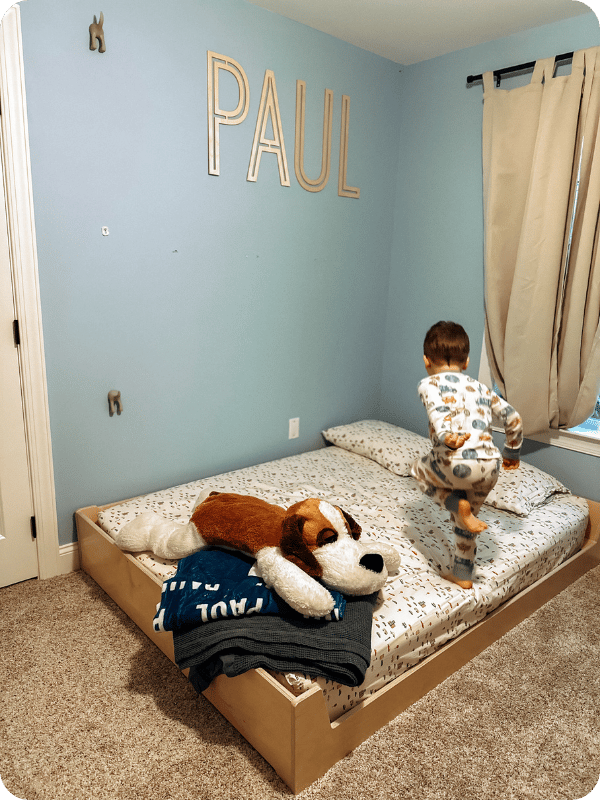
If you think your little one will need help falling asleep or staying asleep during the night, a floor bed can be a great compromise. You can lay with your child to fall asleep, as well as lay with them when they wake up in the middle of the night. Plus, you can select a bed that grows with them into school-age and beyond. This option eliminates another transition from the toddler bed to a big kid bed down the line. We personally used these floor beds for our children and they really helped with the transition. We lay with them every night at bedtime until they fall asleep and leave. It’s actually some of the sweetest moments of our days (and nights!)
No matter how you attempt to transition to a toddler bed, or when, it’s going to come with ups and downs. Remember that you’re doing a great job!
More toddler resources
Parenthood is hard work, but you’re not alone! Our team of child development specialists creates resources to answer your most asked questions about parenting babies, toddlers, and preschoolers.
Whether you need help getting out all that toddler energy during play time or making nutritious, quick meals that help them grow, we’ve got you covered! Check out the Toddler Playbooks or our 15 Minute Family Meals!
Find more free resources on our blog:
- Play activities, crafts, and more
- Understanding infant & toddler development
- Dietary support and recipes for toddlers
- Breast and bottle feeding support
- Tips for starting solids
Sources
- Tao T, Wang L, Fan C, Gao W. Development of self-control in children aged 3 to 9 years: perspective from a dual-systems model. Sci Rep. 2014 Dec 11;4:7272. doi: 10.1038/srep07272. PMID: 25501669; PMCID: PMC5377018.
- Zero to Three. Parent Survey Reveals Expectation Gap for Parents of Young Children. Published 13 October 2016. Accessed July 2026.
- Kremen AM, Block J. The roots of ego-control in young adulthood: links with parenting in early childhood. J Pers Soc Psychol. 1998 Oct;75(4):1062-75. doi: 10.1037//0022-3514.75.4.1062. PMID: 9825535.
Leave a Reply
OTHER POSTS YOU MAY LIKE:




MS, SLP
Founder of Eat Play Say, Speech-Language Pathologist, Feeding Specialist, Play Expert, Mom of 3
Jordyn Koveleski Gorman
SPECIALIZES IN: Infant and toddler speech-language, play, and feeding development, and curating a team that provides expert help that feels like a reassuring text from that one mom friend
EDUCATION: Jordyn received her BS in Speech-Language Pathology from Bloomsburg University and her MS in Speech-Language Pathology from Towson University
FAVE PARENTING FIRST: “The first true smile, it’s the sweetest!”

MS, CCC-SLP, CBS, IBCLC
Speech-Language Pathologist & Feeding Specialist, Certified Breastfeeding Specialist, International Board Certified Lactation Consultant
Jessica Nicholson Cocca
SPECIALIZES IN: Breast and bottle feeding, tongue ties, oral motor dysfunction, starting solids, infant and toddler speech, treating oral motor disorders
EDUCATION: Jessica received her BS in Communication Sciences and Disorders from Pennsylvania State University in 2015 and her MS in Speech-Language Pathology from Towson University in 2017
FAVE PARENTING FIRST: “Baby’s first wave! What a fun first communication gesture!”

MA, CCC-SLP, CLC
Speech-Language Pathologist, Certified Lactation Counselor
Jennifer McFarlin
SPECIALIZES IN: Breast and bottle feeding, tongue ties, starting solids, infant and toddler speech development
EDUCATION: She received her BS in Speech-Language Pathology from Ball State in 2014 and a MA in Speech-Language Pathology from Ball State in 2016.
FAVE PARENTING FIRST: “My favorite baby’s first is their first true smile that just warms your soul knowing they are smiling at you. My other favorite is their first word. I love watching their language explode!”

MS, CCC-SLP
Bilingual Speech-Language Pathologist
Nicole La Petina Kelly
SPECIALIZES IN: Bilingual development (Spanish-English), supporting multilingual families, infant and toddler speech
EDUCATION: She received her BA in Communication Sciences and Disorders and in Spanish from the University of Wisconsin-Madison in 2014 and her MS in Speech-Language Pathology with an English-Spanish Specialization from Marquette University in 2016.
FAVE PARENTING FIRST: “It’s the first slobbery kisses for me!”

RDN, LD
Licensed Registered Dietitian
Kimberly Vede
SPECIALIZES IN: Infant and pediatric nutrition including breastfeeding, formula feeding, and starting solids. She also specializes in prenatal and postpartum nutrition.
EDUCATION: She received her BSc in Biology in 2014 from Life University, and her BSc in Dietetics from Life University in 2019.
FAVE PARENTING FIRST: ”The first time they say ‘mama!’”


This checklist was created with input from a Speech-Language Pathologist, Occupational Therapist and Physical Therapist and has been downloaded over 20,000 times by parents worldwide. Learn the important milestones to pay attention to, and keep it in your digital back pocket during the baby + toddler years!
Comprehensive Milestone Checklist for gross motor, fine motor, and speech-language milestones for 0-36 months,
DOWNLOAD FOR FREE


