


Newborn Feeding Guide
September 3, 2025
Jordyn Koveleski Gorman

Last Updated on March 18, 2026 by Jordyn Koveleski Gorman
If you’re not snuggled up next to a tiny, fresh baby straight from the womb, then you likely will be soon. Let us be one of the first to say congratulations! This is a time that is full of emotion for so many reasons. You’re probably exhausted and undoubtedly overwhelmed.
But you’re not alone! Our team of child development experts are here to help you build confidence and understanding about what your little one needs. As a feeding specialist and mother, I know all too well that the early days of parenting any newborn can be brutal, even as they’re also some of the most beautiful days of your life.
Feeding can be a significant contributor to stress in the newborn phase, but we put together this guide to help ease the overwhelm. Read on for tips about hunger cues, feeding schedules, and navigating cluster feeding!

Newborn hunger cues
Before we dive into charts, ounces, and length of feeds, it’s important to keep hunger cues in the forefront of your mind. Your baby is not a robot, and they likely will not eat at the same time every day. And that’s okay!
Common hunger cues:
- Baby brings hands to mouth (before 2-3 months of age. After ~3 months, this is not always a hunger sign.)
- Baby demonstrates a rooting reflex (turns head to the side, as to look for a nipple).
- Baby is unable to be soothed by other means (e.g., rocking, bouncing, patting on butt, etc.)
- Baby makes a specific cry (parents usually can identify within a few weeks of age!)
Common newborn feeding behaviors:
- It is normal for babies to not always follow a specific routine or eat in exact 2-3 hour increments.
- Nursing to sleep can be common, as suckling at the breast can be soothing as well as nutritious.
- Cluster feeding (at the breast or with bottle feeds) is very common in the first few months of life. After 2-3 months of age, feedings typically spread out. There is more on this below!

Newborn feeding schedule
The “newborn” period is defined by most as babies that are 0-8 weeks old, and some define it as 0-12 weeks old. For the purposes of this blog, we will consider newborns as babies who are 0-3 months old.
Feeding newborn babies, no matter what their age, isn’t so black and white, as each baby will eat on a slightly different schedule. Newborn feeding schedules will change based on growth spurts, nap changes, and more. Just when you think you have a schedule down pat, a new transition will come your way and you’ll have to pivot again.
Despite all the variables of feeding a baby, it’s great to have some general guidelines about how often and how much to feed your newborn! No matter which way you are feeding: nursing, pumping, offering formula, or a combination of all three, below are some sample feeding schedules and quantities to keep in mind.
How often to feed a newborn
On average, newborn babies eat about 8-12 times in a 24 hour period, which is about every 2-3 hours around the clock.
It is important to keep the phrase “feed on demand” in mind as you are feeding your newborn. This means focusing first on your baby, and secondly on the clock. When baby shows that they are hungry, it’s important to offer a feeding, no matter the time on the clock.
To ensure that your newborn baby is eating often enough, it’s important to not go too long between feedings. If your baby is approaching the 3-hour mark between feedings and is sleeping, it is recommended to wake baby to feed. This is especially important if they are still gaining back weight that they may have lost in the first week or two after birth. Talking with your pediatrician will be important to best understand your baby’s feeding needs.

How much to feed a newborn
You’re going to hear this a lot, but it’s important: every baby is different! There are many factors that impact how much milk your little one takes at each feeding. The makeup of their milk, whether it is formula, breastmilk, or a combination of both, will play a role. Additionally, your own baby’s individual appetite will factor in.
Some babies prefer smaller feeds more frequently, while others are able to tolerate more milk and longer gaps. What’s important to remember is that, for a newborn, feeding is around the clock regardless of how much they consume. Gaps of 2-3 hours will feel short, because they are! Over time, as your baby grows, they will tolerate longer gaps between feeds. And cluster feeding will pass. This season is short. I promise!
How much breastmilk does a newborn need?
If your baby is exclusively nursing (no pumping or bottles), you won’t know exactly how much they are consuming at each feeding. That can feel stressful. Watching for your baby’s fullness cues, feeding on demand, and monitoring wet/poopy diapers are great ways to know if they are getting enough.
A 1-day old baby generally takes between 5–7ml per feed. The fresh newborn tummy is tiny!
By day 3, your newborn may take between 22–27ml per feeding. In just a few days, their stomachs have adapted to receive quadruple the amount that they took in on day one. Wild, huh?!
At one week of age, baby may take between 45–60ml, which is 1.5–2oz, at every feeding. From here, their stomach growth stabilizes a bit. Their intake will continue to increase slowly from ages 1–3 months, where they may take 2.5–5oz at each feed.
As a note, babies who primarily nurse may take smaller bottles when offered, compared to babies who take mainly bottles. Additionally, pumping only 2.5oz from both breasts may be normal for some moms and babies. Remember: every baby is different, so use these numbers as a general guideline rather than a hard and fast rule!

How much formula does a newborn need?
In the first three days, formula feeding may mirror breastmilk in terms of amount consumed. When your baby is first born, their stomach is only the size of a marble. That’s true no matter what milk they consume!
Expect a formula-fed newborn to take in between 5–7ml on the first day or two of life, at every feeding. By day 3, they may take around one ounce, give or take a few milliliters. As they grow toward one week, most formula-fed babies will take between 1–2oz.
By one month of age, we expect to see formula fed babies taking between 3–4oz of formula at a time. However, this also generally contributes to a little bit longer window between feeds. Some newborns receiving formula can lengthen windows to 3–4 hours between feeds by 1 month of age, or 6-8 feedings per day.
At 2–3 months, most formula fed newborns consume between 4–6oz of formula per feed, with 5–6 total feedings per day.
Remember, these are all general averages. On average, a baby should be consuming 2.5oz of formula for every pound they weigh in a 24-hour period. For help selecting the best bottle for your baby, check out our guide on the best bottle choices!
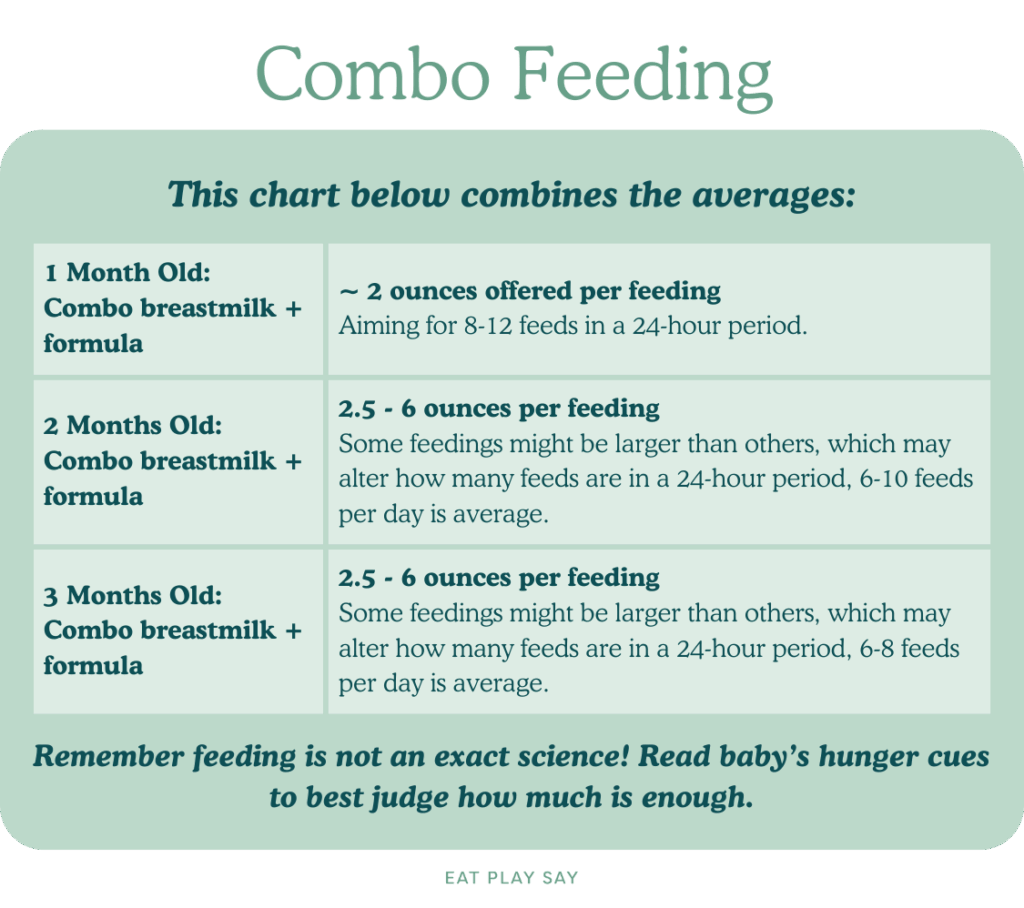
How much milk during combination feeding?
It’s harder to give exact feeding volumes for combo feeders. Every journey is different! Typically, babies who exclusively receive formula tend to have a higher daily intake than exclusively breastfed babies. If you need help introducing the bottle to your baby, check out this blog.
When it comes to combo feeding, the volume averages will likely fall somewhere in between. Check out the chart below for guidance on combo feeding amounts.
How long are newborn feedings?
Typically, feedings at the breast or with a bottle should take no more than about 20 minutes. Some feeds may be shorter and some longer, but newborn babies should take full feeds in about 20 minutes.
If you are noticing that feedings are taking very long, upwards of 30 minutes, or feeds feel like a struggle at the breast or with a bottle, reaching out to a lactation consultant/feeding specialist and your pediatrician is recommended.
Navigating cluster feeding
If your baby is showing signs of hunger more often than “normal” for them, or more often than 8-12 times in a 24 hour period, you’re likely experiencing cluster feeding.
Sometimes cluster feeds are very short. Other times, cluster feeding looks like your newborn eating their “typical” amount more often. This is very normal, and is usually accompanied by a growth spurt soon after. As exhausting as this period of time can be, this is a moment worth celebrating. It means your baby is growing!

Newborn cluster feeding
Cluster feeding while nursing
If you are nursing and baby is showing signs of cluster feeding, bring baby to your breast often and answer those hunger cues when you see them. This is great for helping establish your milk supply, as breastfeeding relies heavily on supply and demand. It can feel like you’re feeding your baby every hour, but rest assured: cluster feeding does not last forever!
Cluster feeding while pumping
If you are offering baby expressed breastmilk in a bottle and noticing signs of cluster feeding, it can be overwhelming. Making bottles of breastmilk several times a day and not knowing how much baby will take each time is hard!
Our best advice? Leave a bottle of pumped milk in the fridge that you can pull from when you notice your baby is cluster feeding. Pour from that bottle and try to offer one ounce or so at a time during those “extra” cluster feeding sessions. This way, if baby doesn’t finish the bottle during one of their cluster feeding sessions and the bottle “expires,” you aren’t losing too much milk. You can also freeze it and save it for a milk bath later!
If you start to offer a bottle of breastmilk to baby and they do not finish it, it’s best to offer the remainder of the bottle within 2 hours. After 2 hours, that bottle is “expired,” and it’s best to discard that milk as there is a risk for bacterial growth. (1)
Cluster feeding while formula feeding
Using the “pitcher method” is a great solution for cluster feeding when offering formula. Make a pitcher of all the formula your baby is likely to drink that day. Put it in the fridge and set a reminder for 24 hours, as that’s when it expires. Make sure to carefully mix the correct amount of water with the formula.
When it’s time for a bottle, pour the formula into the bottle and serve. For babies cluster feeding, this is a great way to have formula mixed and on hand. You can make a new bottle quickly when baby shows signs that they’re hungry.
Remember that if baby doesn’t finish a bottle, you can offer what remains within one hour from when feeding begins. Once the nipple is in baby’s mouth, bacteria can grow, hence the shortened window of recommended use after drinking begins. (1)
Cluster feeding while combination feeding
A combination of the guidelines in the above sections will likely work best for mothers who are combo feeding their newborns using breastmilk and formula. Our blog has more information on combination feeding and how to prioritize your breastmilk supply while also offering formula.
More newborn support
Each day of feeding a newborn may look different. It’s not that you’re doing anything wrong, it’s just that they are changing before your eyes. Remember to read your baby’s cues over all else, and keep these schedules in mind as you go.
Now that you’re feeling more confident about feeding, you can discover some fun ways to bond and play with your newborn!
If you need more support, check out our resources for infants!
Sources
- https://www.cdc.gov/infant-toddler-nutrition/formula-feeding/preparation-and-storage.html
Leave a Reply
OTHER POSTS YOU MAY LIKE:




MS, SLP
Founder of Eat Play Say, Speech-Language Pathologist, Feeding Specialist, Play Expert, Mom of 2
Jordyn Koveleski Gorman
SPECIALIZES IN: Infant and toddler speech-language, play, and feeding development, and curating a team that provides expert help that feels like a reassuring text from that one mom friend
EDUCATION: Jordyn received her BS in Speech-Language Pathology from Bloomsburg University and her MS in Speech-Language Pathology from Towson University
FAVE PARENTING FIRST: “The first true smile, it’s the sweetest!”

MS, CCC-SLP, CBS, IBCLC
Speech-Language Pathologist & Feeding Specialist, Certified Breastfeeding Specialist, International Board Certified Lactation Consultant
Jessica Nicholson Cocca
SPECIALIZES IN: Breast and bottle feeding, tongue ties, oral motor dysfunction, starting solids, infant and toddler speech, treating oral motor disorders
EDUCATION: Jessica received her BS in Communication Sciences and Disorders from Pennsylvania State University in 2015 and her MS in Speech-Language Pathology from Towson University in 2017
FAVE PARENTING FIRST: “Baby’s first wave! What a fun first communication gesture!”

MA, CCC-SLP, CLC
Speech-Language Pathologist, Certified Lactation Counselor
Jennifer McFarlin
SPECIALIZES IN: Breast and bottle feeding, tongue ties, starting solids, infant and toddler speech development
EDUCATION: She received her BS in Speech-Language Pathology from Ball State in 2014 and a MA in Speech-Language Pathology from Ball State in 2016.
FAVE PARENTING FIRST: “My favorite baby’s first is their first true smile that just warms your soul knowing they are smiling at you. My other favorite is their first word. I love watching their language explode!”

MS, CCC-SLP
Bilingual Speech-Language Pathologist
Nicole La Petina Kelly
SPECIALIZES IN: Bilingual development (Spanish-English), supporting multilingual families, infant and toddler speech
EDUCATION: She received her BA in Communication Sciences and Disorders and in Spanish from the University of Wisconsin-Madison in 2014 and her MS in Speech-Language Pathology with an English-Spanish Specialization from Marquette University in 2016.
FAVE PARENTING FIRST: “It’s the first slobbery kisses for me!”

RDN, LD
Licensed Registered Dietitian
Kimberly Vede
SPECIALIZES IN: Infant and pediatric nutrition including breastfeeding, formula feeding, and starting solids. She also specializes in prenatal and postpartum nutrition.
EDUCATION: She received her BSc in Biology in 2014 from Life University, and her BSc in Dietetics from Life University in 2019.
FAVE PARENTING FIRST: ”The first time they say ‘mama!’”


This checklist was created with input from a Speech-Language Pathologist, Occupational Therapist and Physical Therapist and has been downloaded over 20,000 times by parents worldwide. Learn the important milestones to pay attention to, and keep it in your digital back pocket during the baby + toddler years!
Comprehensive Milestone Checklist for gross motor, fine motor, and speech-language milestones for 0-36 months,
DOWNLOAD FOR FREE


