


High Contrast Toys for Infants
December 16, 2025
Jordyn Koveleski Gorman

Last Updated on December 16, 2025 by Jordyn Koveleski Gorman
This page contains affiliate links. We will receive a commission on qualifying purchases using these links.
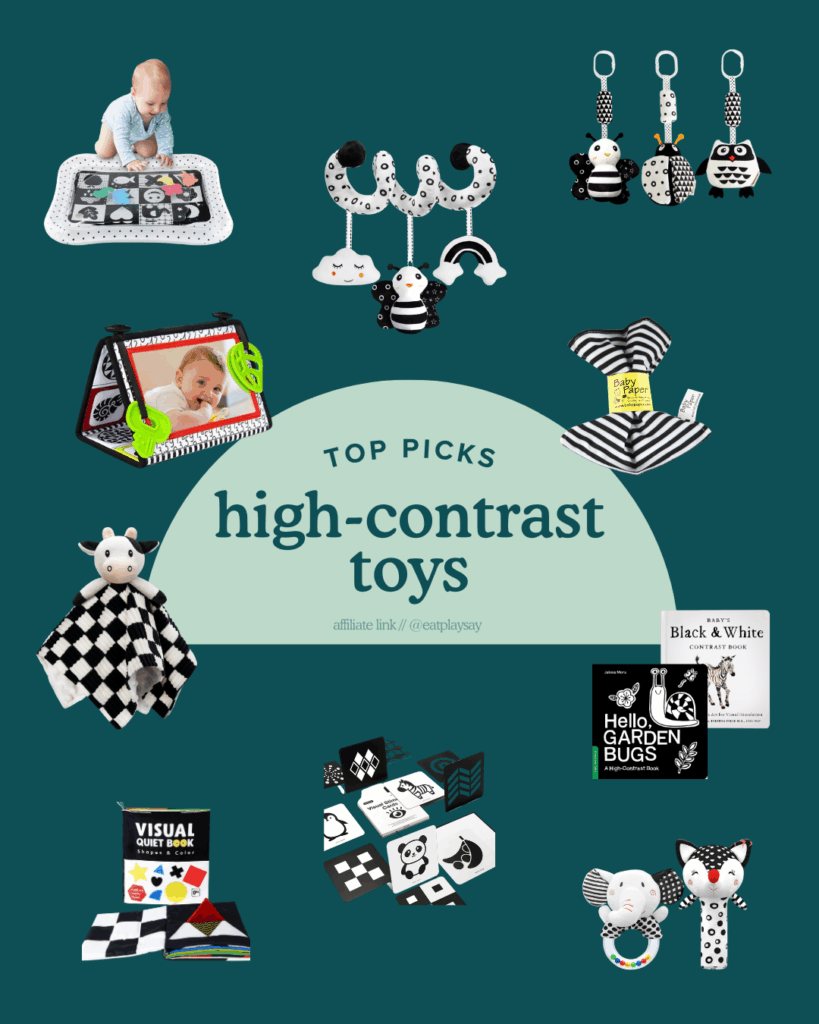
You may have heard that high-contrast toys are some of the best options you can buy for newborns. But, there’s a big difference between a 3-week-old and a 3-month-old. So what do you buy, and when?
Let’s break it down!
What is a high-contrast toy?
A high-contrast toy is a toy designed with bold, opposite colors. Typically they are black and white, but you may see other colors like red and white or black and yellow. High-contrast toys usually include bold patterns and clear shapes and edges. They are designed for visual stimulation to support early cognitive and sensory development. High-contrast toys are most commonly marketed to infants and newborns.
Why should I buy high-contrast baby toys?
High-contrast toys pack a great bang for their buck, especially in the newborn stage.
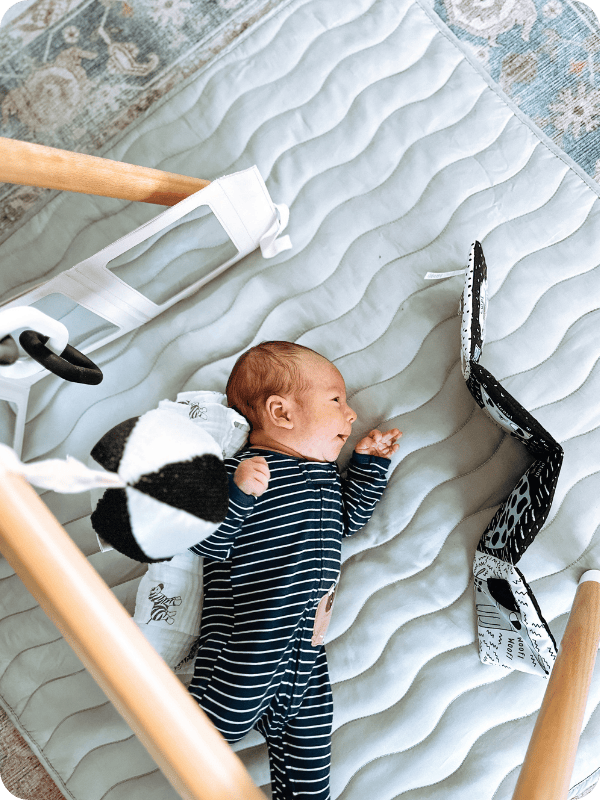
Newborns have limited vision and don’t see the world the way we do. They can only focus on objects within 8–12 inches of their face—and even then, everything is blurry. High-contrast items are much easier for babies to see and focus on, which is why black-and-white infant toys are so common.
High-contrast toys also support visual development. They help strengthen eye muscles, encourage tracking, and hold a newborn’s attention more effectively than low-contrast items. Not only that, but they stimulate brain development as well. When babies look at bold, contrasting patterns, it activates neural pathways that support early cognitive growth.
And if you need another reason to add high-contrast toys to your baby’s routine—they’re incredibly helpful during tummy time. Because babies can see high-contrast toys more clearly, they’re naturally drawn to look up or side to side. They keep infants engaged and encourage them to lift their head and explore.
Top 10 High-Contrast Toys
Not every toy is created equally! Read on to find out which black-and-white infant toys earned a spot in our top 10 picks and why we love them. We’ve also included play tips for each toy so you can keep playtime engaging and fun.
01. Baby Board Books

High-Contrast Board Books
The benefits of high contrast aren’t just reserved for toys. Reading high-contrast books to newborns is great for their development! Not only will they be working on eye strength and tracking when looking at the pages, but they will be learning, too.
Reading to babies helps with language development, visual and listening skills, and more. It’s also a great way to bond with your baby and build connection.
These are some of our favorite high-contrast books for infants.
Ways to play:
- For newborns, don’t focus as much on the words in the book. Keep it short and sweet, pointing out one thing on a page at a time.
- Give your baby time to look at the page and take in the images.
- You can move the book back, forth, up, and down to let your infant work on visual tracking.
02. Black-and-White Sensory Book

High-Contrast Sensory Book
This soft book provides a way for baby to engage with high-contrast patterns while incorporating sensory exploration. The pages are made of different materials, allowing baby to explore through touch. They crinkle and can squeak, too.
As your newborn grows, you can continue to use this book. There are flaps and interactive pieces on the pages for little ones to explore.
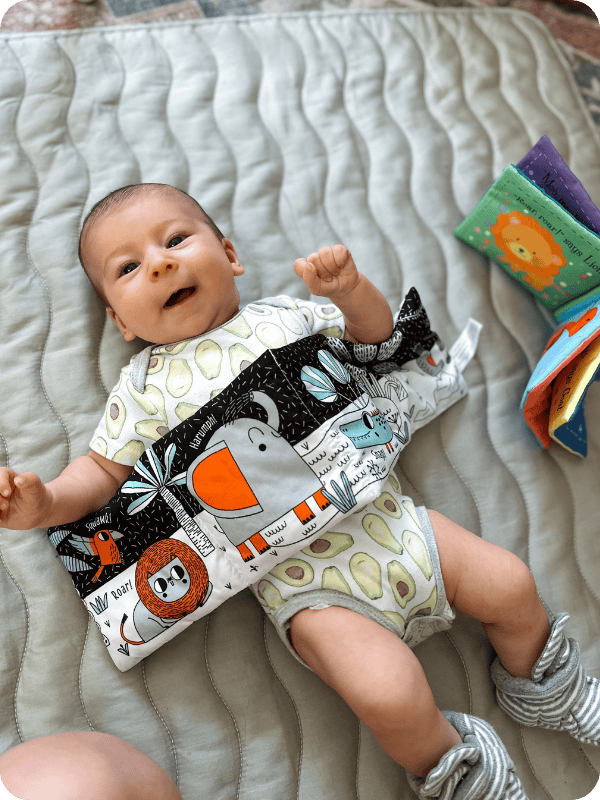
Ways to play:
- Place the open book flat on the floor in front of your baby during tummy time to give them something to look at.
- Model reaching out and touching the book during tummy time, or label what you point to.
- Hold the book in front of baby and slowly move it back and forth to work on visual tracking.
03. Tummy Time Mat
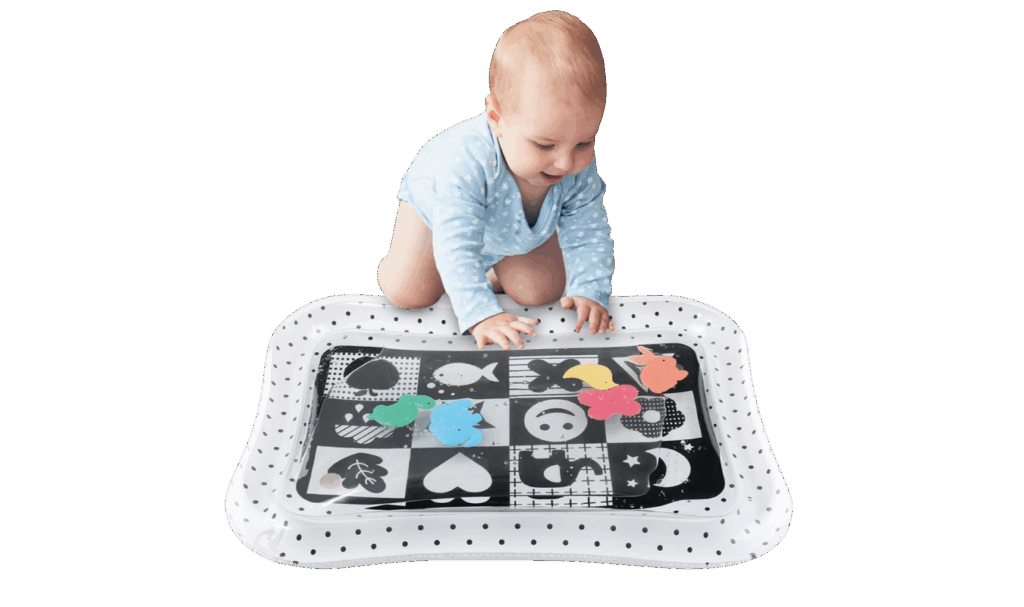
Tummy Time Water Play Mat
Lots of tummy time mats are made with bright colors, but I love this one’s focus on high-contrast images. Your baby gets all the benefits of tummy time while having something visually stimulating to look at.
The colorful animals float, giving your baby something to track with their eyes. As they push themselves up on the mat to see better, they’ll be strengthening the muscles in their shoulders, arms, neck, and core.
Ways to play:
- Lay your baby on their tummy and get down at eye level—they love looking at you! Sing songs or make silly faces.
- Gently press on the water mat to get the objects to float in different directions.
04. Stroller & Car Seat Toy
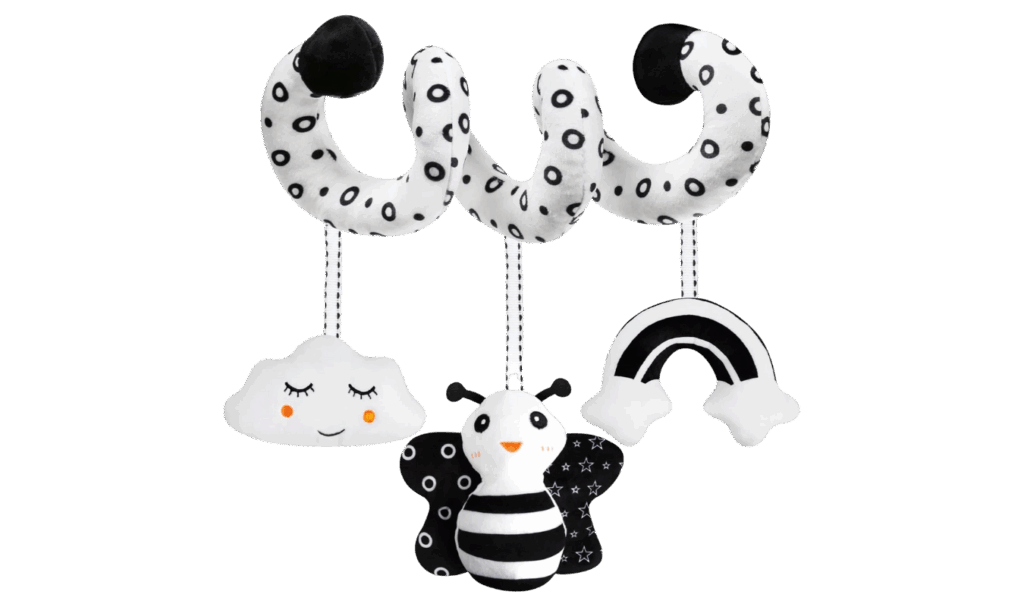
High-Contrast Spiral Hanging Toy
This is a great high-contrast toy for on-the-go. The black-and-white toy wraps around your car seat handle, giving your newborn something visually stimulating to look at while riding. You can also wrap it around your stroller!
Ways to play:
- You can use this toy anywhere it can hang safely—on the car seat, stroller, or crib bars.
- Shake it to make it rattle, and move it toward and away from your baby to see if they try to reach for it.
05. Baby Rattles
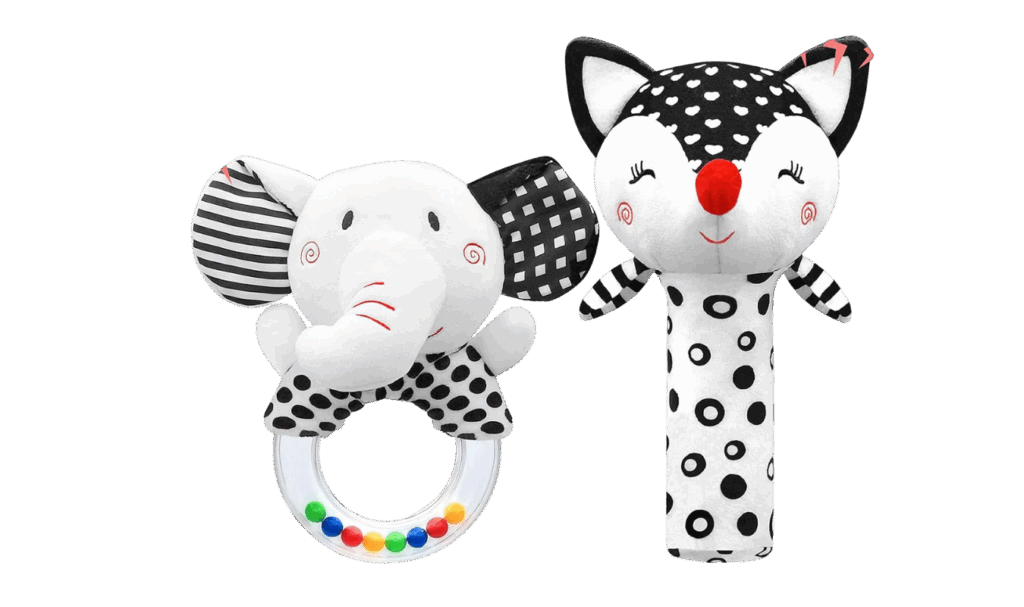
2-Pack Black-and-White Baby Rattles
Rattles are simple, classic toys that support newborn development. In fact, a rattle can be one of the first toys to introduce your baby to cause and effect—when they shake it, it makes a sound. High-contrast rattles also stimulate vision, hearing, and touch.
We love high-contrast foot and ankle rattles, too! Every time your newborn moves, they hear a sound, reinforcing cause and effect and encouraging exploration.
Ways to play:
- Use functional language from the start by saying the word “shake” as you play with your baby.
- Hold the rattle above your baby’s head and move it slowly to support visual tracking.
- Gently shake the rattle in front of them during tummy time to keep them engaged.
- Create a simple routine with the rattle—for example, shake it and sing a song together at the start of every diaper change.
06. Hanging Toys for Play Gym
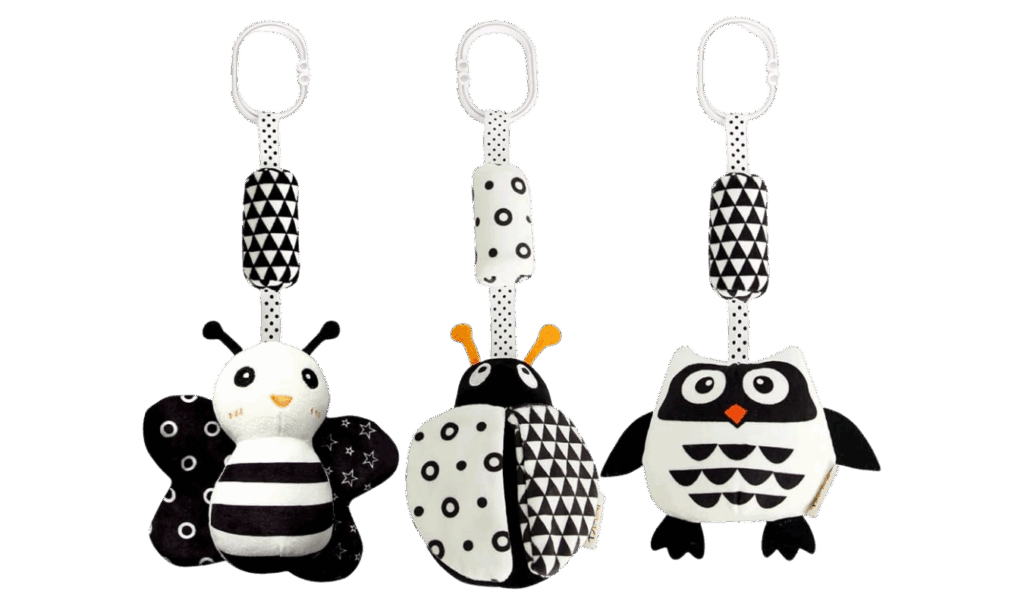
High-Contrast Hanging Toys
Many parents have some type of activity gym, but it doesn’t always include high-contrast colors and patterns, which are best for newborns. These affordable hanging toys are a great solution! They contain small bells that sound like wind chimes when they move.
As your baby grows and their vision improves, you can switch to more colorful hanging toys to keep things interesting.
Ways to play:
- These hanging toys come with a C-hook, making them easy to put on and take off. Don’t forget all the places you can use them—the car seat, the stroller, or even during tummy time.
- As your baby gets older, they’ll also love the sounds these toys make when they bat at or kick them.
07. High-Contrast Cards
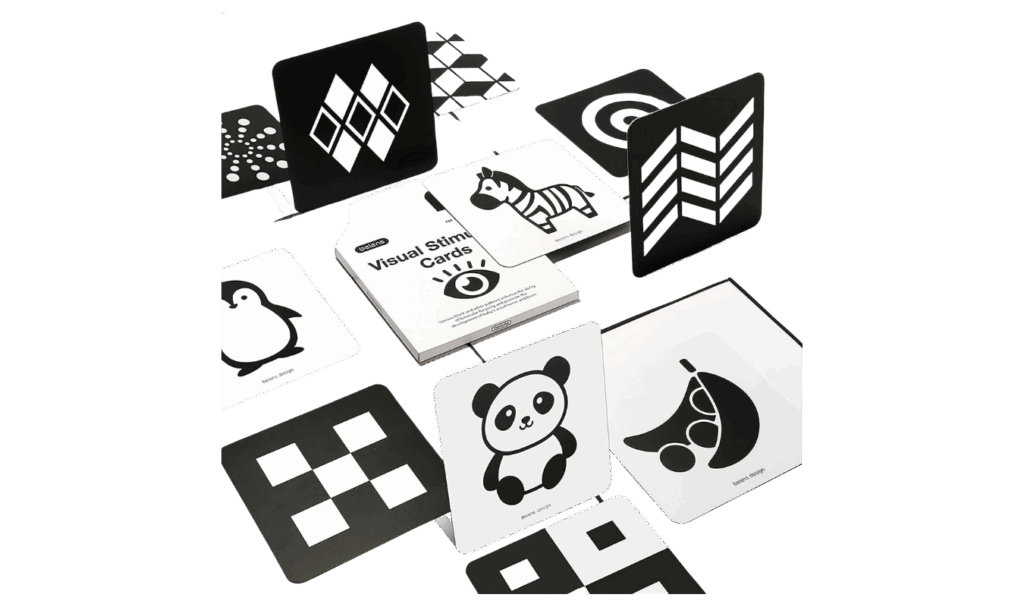
High-Contrast Flash Cards
Flash cards are an inexpensive way to introduce high-contrast pictures and patterns wherever you are. Keep a few around the house, in the diaper bag, or at grandparents’ homes.
They’re great for visual stimulation! As your baby looks at them, their brain is developing too.
Ways to play:
- Place the cards in front of your baby during tummy time to give them something interesting to look at.
- Use them to support visual tracking by moving the cards slowly back and forth or side to side.
- Change up your newborn’s position as they gaze at the cards—side-lying, on their tummy, or while you hold them in your lap.
08. Tummy Time Mirror
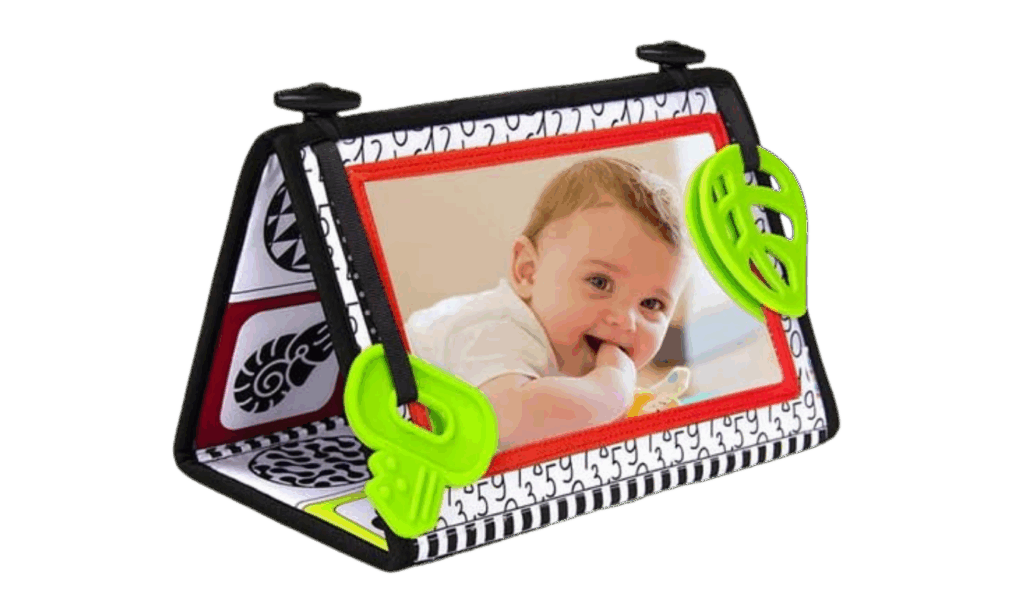
Tummy Time Baby Mirror
We love mirror toys for babies for many reasons. They help with visual focus, encourage body awareness, support tummy time, and provide low-stimulation play.
Let’s be honest—humans enjoy looking at themselves! Babies can see their own reflection and are instantly intrigued. Watching their own face and expressions helps spark early social and emotional development.
This mirror toy features high-contrast patterns along the border and on the other sides, giving you the benefits of both a high-contrast toy and a mirror in one.
Ways to play:
- Mirrors make great tummy time toys! Get down on the floor at their level so they can watch both their expressions and yours.
- Play peekaboo behind the mirror and pop up to surprise your baby.
09. Crinkle Toy
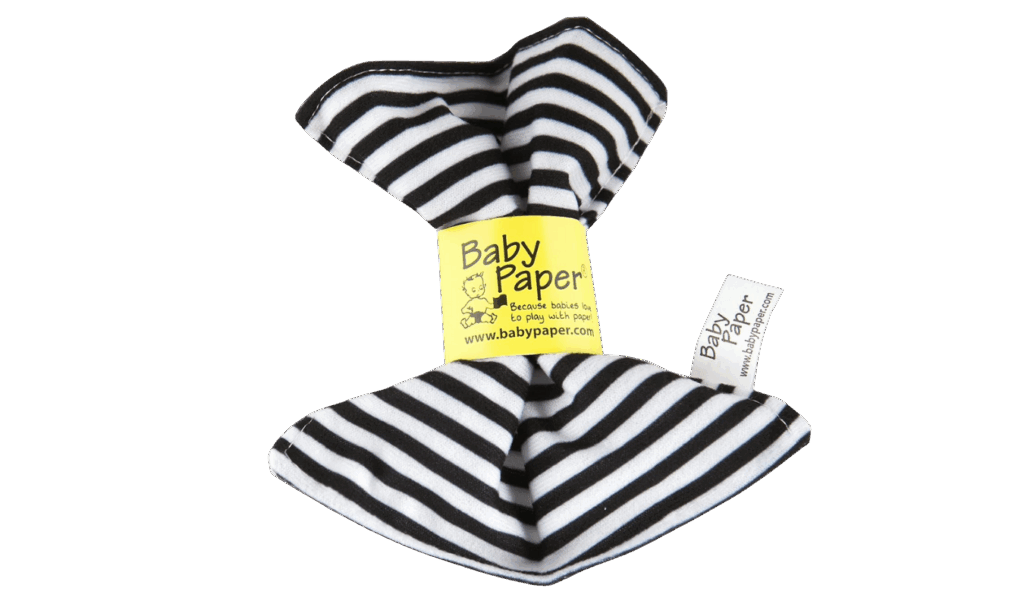
Black-and-White Baby Paper
This baby paper makes a perfect high-contrast toy for babies. It’s soft and lightweight, yet produces an engaging crinkle sound when handled.
The texture of crinkle toys like this encourages tactile play, helping babies grasp and squeeze while exploring what’s in their hands. It’s safe and easy to take anywhere you go!
Ways to play:
- Start by letting your baby hear the sound! Hold the toy 8–12 inches in front of them and crinkle it, pausing between sounds.
- Mix it up by playing peekaboo.
- Use high-contrast crinkle toys to help practice visual tracking
10. Baby Lovey

High-Contrast Checkerboard Lovey
Babies love exploring soft, cuddly textures. Many parents introduce a stuffed animal or small blanket that stays with baby throughout the day and during travel—often called a lovey. A lovey acts like a security blanket, helping baby feel safe and comfortable even in new environments.
A black-and-white lovey like this is a great way to incorporate high-contrast stimulation into everyday moments.
Ways to play:
- Help your baby explore the lovey’s texture with their hands and face. Run their hands against the fuzzy, soft blanket and gently rub it against their cheek.
- It’s a great toy to use during cuddle time!
- Use a lovey during tummy time, or play peekaboo during floor time.
Looking for more?
High-contrast toys and tummy time go hand in hand for newborns. Check out our favorite tummy time toys for even more ways to play and engage your baby.
Discover our top picks for toys that delight babies and toddlers! From high-contrast newborn favorites to engaging toys that will grow with them through toddlerhood. These carefully chosen toys make playtime fun and full of learning opportunities.
Leave a Reply
OTHER POSTS YOU MAY LIKE:



MS, SLP
Founder of Eat Play Say, Speech-Language Pathologist, Feeding Specialist, Play Expert, Mom of 2
Jordyn Koveleski Gorman
SPECIALIZES IN: Infant and toddler speech-language, play, and feeding development, and curating a team that provides expert help that feels like a reassuring text from that one mom friend
EDUCATION: Jordyn received her BS in Speech-Language Pathology from Bloomsburg University and her MS in Speech-Language Pathology from Towson University
FAVE PARENTING FIRST: “The first true smile, it’s the sweetest!”

MS, CCC-SLP, CBS, IBCLC
Speech-Language Pathologist & Feeding Specialist, Certified Breastfeeding Specialist, International Board Certified Lactation Consultant
Jessica Nicholson Cocca
SPECIALIZES IN: Breast and bottle feeding, tongue ties, oral motor dysfunction, starting solids, infant and toddler speech, treating oral motor disorders
EDUCATION: Jessica received her BS in Communication Sciences and Disorders from Pennsylvania State University in 2015 and her MS in Speech-Language Pathology from Towson University in 2017
FAVE PARENTING FIRST: “Baby’s first wave! What a fun first communication gesture!”

MA, CCC-SLP, CLC
Speech-Language Pathologist, Certified Lactation Counselor
Jennifer McFarlin
SPECIALIZES IN: Breast and bottle feeding, tongue ties, starting solids, infant and toddler speech development
EDUCATION: She received her BS in Speech-Language Pathology from Ball State in 2014 and a MA in Speech-Language Pathology from Ball State in 2016.
FAVE PARENTING FIRST: “My favorite baby’s first is their first true smile that just warms your soul knowing they are smiling at you. My other favorite is their first word. I love watching their language explode!”

MS, CCC-SLP
Bilingual Speech-Language Pathologist
Nicole La Petina Kelly
SPECIALIZES IN: Bilingual development (Spanish-English), supporting multilingual families, infant and toddler speech
EDUCATION: She received her BA in Communication Sciences and Disorders and in Spanish from the University of Wisconsin-Madison in 2014 and her MS in Speech-Language Pathology with an English-Spanish Specialization from Marquette University in 2016.
FAVE PARENTING FIRST: “It’s the first slobbery kisses for me!”

RDN, LD
Licensed Registered Dietitian
Kimberly Vede
SPECIALIZES IN: Infant and pediatric nutrition including breastfeeding, formula feeding, and starting solids. She also specializes in prenatal and postpartum nutrition.
EDUCATION: She received her BSc in Biology in 2014 from Life University, and her BSc in Dietetics from Life University in 2019.
FAVE PARENTING FIRST: ”The first time they say ‘mama!’”


This checklist was created with input from a Speech-Language Pathologist, Occupational Therapist and Physical Therapist and has been downloaded over 20,000 times by parents worldwide. Learn the important milestones to pay attention to, and keep it in your digital back pocket during the baby + toddler years!
Comprehensive Milestone Checklist for gross motor, fine motor, and speech-language milestones for 0-36 months,
DOWNLOAD FOR FREE


All of these are brilliant! Looking to improve my setup with my second baby coming soon.