


Activities for 2 Year Olds
February 6, 2026
Jordyn Koveleski Gorman

Last Updated on February 6, 2026 by Jordyn Koveleski Gorman
This page contains affiliate links. We will receive a commission on qualifying purchases using these links.
Two year olds. Am I right?
They’re everything magical and hilarious, and they’re way smarter than you ever could’ve imagined. And they’re also testing boundaries, asking tons of questions, and probably climbing all over you like a jungle gym. Their energy is a gift, but it is also so hard to keep up!
Balancing play with developmental growth starts to feel high pressure for a lot of parents around this time. Things like flash cards, alphabet memorization, and quizzes on the color wheel start looking really tempting. But there’s good news: you don’t need any of that!
What your little one needs is to keep on playing! At this age, play works by enhancing the structure of toddlers’ brains, improving function and helping them build executive function. (1) This means that the path to successful learning later is paved by the play your child engages in now.
So shake off the pressure to quiz your toddler, and remember: play is an important part of development! (2)
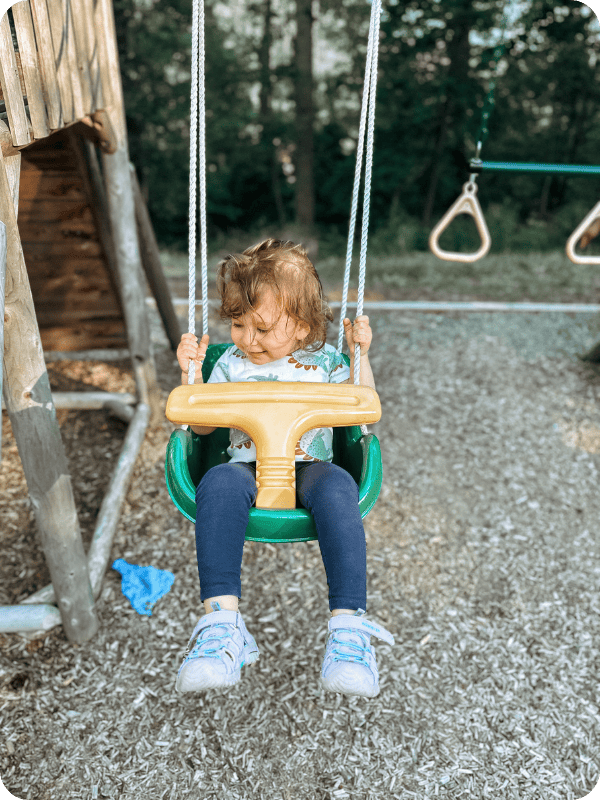
2 year old milestones
Some of the milestones we expect to see in 2 year olds are:
- Engages in pretend play activities
- Puts away toys on request and follows 2-step directions, such as “pick up the diaper and throw it in the trash.”
- Strings a 1-inch bead or block
- Uses ~50 different words
- Self-feeds with fingers and utensils with minimal assistance
- Turns book pages 1 at a time
- Runs without falling
- Jumps in place or off a small step
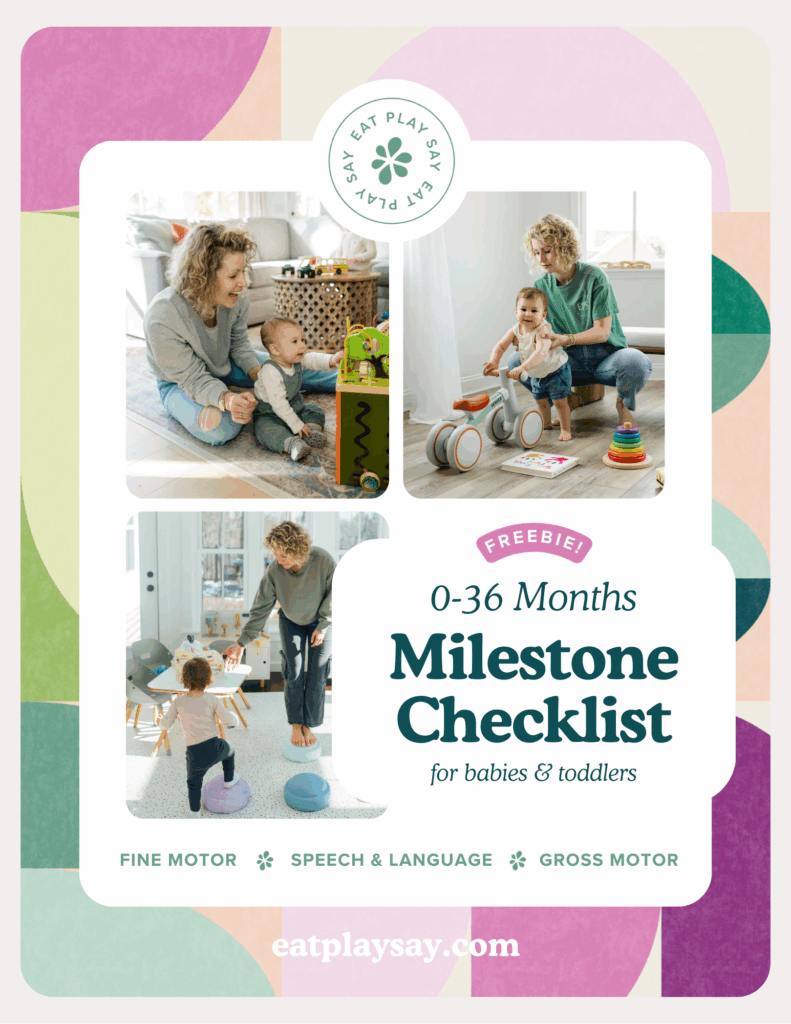
These are just some of the expected milestones for 2 year olds. Every toddler is different and progresses through developing skills in their own way, so it’s okay if there is a little variation! To check and see where your toddler might need extra support, download our free Milestone Checklist for 0–36 months!
Developmental activities for 2 year olds
Some of our favorite toys and activities for this age are timeless, growing with toddlers into their preschool era. Activities that help little ones explore their imagination, such as pretend play, are evergreen. Not sure what to play? Give your little one two choices, and let them build confidence in their decision making skills!
Here are our top 5 learning activities for 2 year olds:
Tricycle time! What toddler doesn’t love riding around on a classic Radio Flyer? Whether it’s a trike or another ride-on toy, they’re great for gross motor development and provide your toddler with independence. Some can even be used inside, which is great for burning before-bed energy.
Arts and crafts! Two year olds love exploring a craft cart. For a simple activity they’ll love again and again, try out a paper roll on a mark-safe surface and pair it with age-appropriate markers or crayons! For on-the-go crafting, we love using water markers like these. This creative play doubles as a fine motor activity, which helps prepare toddlers for future writing skills.
Pretend kitchen play! One of the longest lasting toys we own is this ice cream shop set. Two year olds can practice speech-language skills all day long while taking turns being the employee or the customer! Model longer phrases like “I want a big ice cream cone!” or “I want more scoops!” As they get older, you can model colors and more descriptive phrases like “My ice cream is so cold!” Almost any pretend kitchen set can provide these learning opportunities for your little one!
Books and puzzles! Both of these activities offer fine motor development (turning one page at a time is a milestone!) and speech-language opportunities. Our favorite books for two year olds encourage toddlers to finish phrases, dance around, and explore new concepts in approachable ways! Puzzles that tend to work best have chunky pieces, lots of contrast, and don’t have too many pieces.
Cars, cars, cars! Whether you have a classic road rug or use painter’s tape on the floor to make a highway, little ones thrive with this activity. You can use your own childhood Hot Wheels or pick up some new cars for your child! Don’t be afraid to join in, modeling phrases like “The car goes beep beep!” and practicing “stop!” and “go!”
For a complete list of our recommended toys, books, and utensils for two year olds, check out our favorites list!
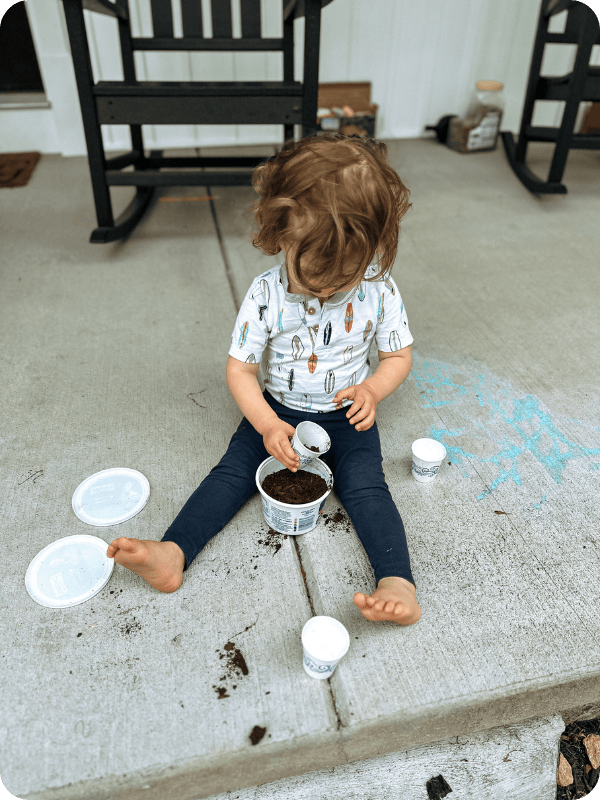
Sensory activities for 2 year olds
The world has never been more exciting than it is right now. Every sound, sight, and smell is calling your little one’s name to explore. Providing your child with opportunities to safely explore their senses through sensory play is great for their development!
Some of our favorite sensory activities for 2 year olds are:
- Set up a water station! You can do this on the floor with a towel, in the bathtub, or outside. Fill bowls of various sizes with water and grab some nonbreakable kitchen items, like cups, measuring spoons, a funnel, etc. Let your little one dump and splash! Make it a fun learning moment by asking questions about what’s happening. “What is the cup doing? Yes! It’s floating!” Point out verbs like “splash, pour, scoop.”
- To practice the motion of putting two hands together to catch a ball, blow bubbles to your little one and have them “clap” the bubbles! See how many they can clap, trying to blow extra large bubbles so they can focus in on the bubble before they “clap” it!
Crafts for 2 year olds
The best crafts are simple, don’t take too much time, or require an insane supply list. Great news: that’s all the crafts from Eat Play Say! Even if you’re not big on crafting, you’ll actually want to do these with your toddler. We’ve got your back!
Our top crafts for 2 year olds are:
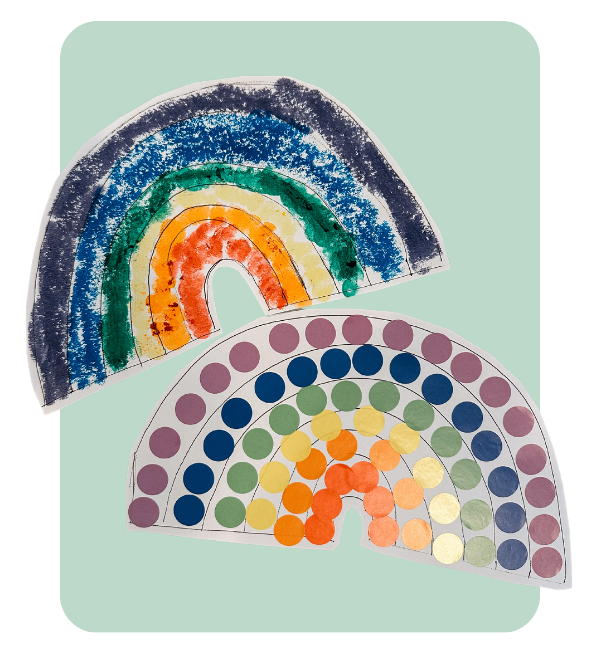
Paint & sticker rainbow
Supplies needed: construction paper, glue, marker/crayons, dot stickers, paint stick
Time to complete: 10 minutes
Ages appropriate: 9+ months
Fine motor skills it supports: bilateral coordination (using two hands together), fine motor manipulation and coordination, pincer grasp, writing utensil grasp, hand strengthening, motor planning
- To set up the craft, draw a rainbow outline, leaving space for your little one to put stickers down or color in each line.
- Draw red dots along the red row, orange dots along the orange row, etc. This will give your little one a target for where to place their sticker or color. Let your little one make the dots or make them together!
- You can help your little one run a paint stick all over the rainbow or model picking up a sticker with your pincer finger and thumb and placing it on the corresponding color.
- Provide as much or as little assistance as your little one needs!
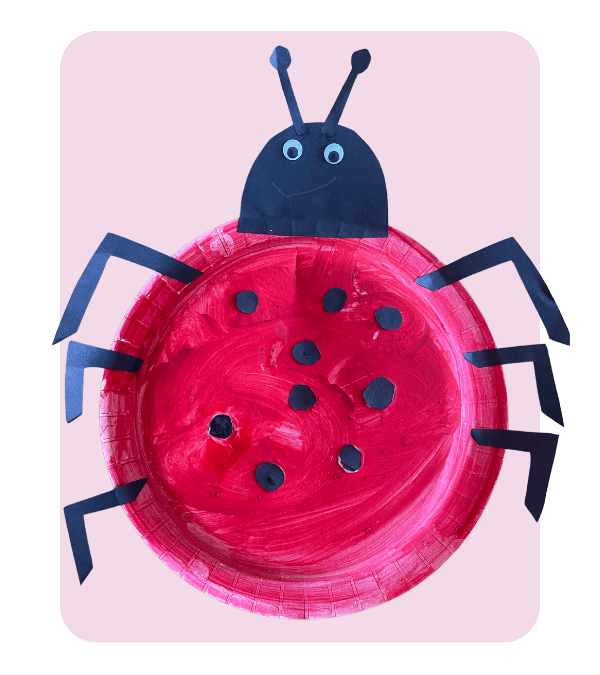
Paper plate lady bug
Supplies needed: paper plate, construction paper, glue, scissors, pipe cleaners, paint/paint sticks/markers/crayons
Time to complete: 10 minutes
Ages appropriate: 12 + months
Fine motor skills it supports: bilateral coordination, fine motor manipulation and coordination, pincer grasp, writing utensil grasp, hand strengthening, motor planning, scissor skills
- Help your little one paint the paper plate red using paint or paint sticks. You can also color the paper plate red by using markers or crayons.
- While the paper plate is drying, cut out one large semi-circle and 8 smaller circles from black construction paper. Your little one can practice drawing a “v” shape, and you can help them cut out the 6 legs.
- Glue the semi-circle to the top of the paper plate (the ladybug’s head), then glue the circles all over the body (the spots). Finish by gluing on 3 legs to each side.
- Draw on a face with a white crayon and glue down googly eyes. You can also glue two pipe cleaners to the top for the antennae or make them out of construction paper!
For more crafts just like these, check out our catalogue of downloadable craft freebies for every season and tons of holidays!
Gross motor activities for 2 year olds
Gross motor skills like climbing, jumping, and running are really taking off from ages 2–3. Jumping in particular is one of the cutest skills to watch develop. Have you ever seen a toddler focus insanely hard on jumping, only to lift the heel of their foot half a millimeter off the ground? It’s amazing. You can help them master it with a few focused activities!
Our favorite gross motor development activities for 2 year olds are:
- Put the playground to work! There are tons of opportunities for gross motor development at the playground. Have your little one get on the seesaw to work on pushing off with their legs. Then, climb the ladders to work on balance and core strength, or hang from the monkey bars or ride the zip line. Finish by having your toddler sit on the big kid swings, letting them try to balance while being gently pushed.
- Have a puzzle relay race. Put the pieces at one end of the room and the board on the other side. Throw in some obstacles along the way! Climbing over couch cushions or jumping over a rolled towel are great options. They’ll grab a puzzle piece, weave through the obstacles, and then put it in place! Then head back to the beginning and keep going until the puzzle is complete!
Fine motor activities for 2 year olds
You’ve seen tons of fine motor activities sprinkled throughout this blog. That’s because fine motor skills are being majorly fine-tuned at two! Supporting your little one as they practice new skills (and sometimes struggle with them) can be done in a low-stress play environment. Big win!
The best fine motor activities for two year olds are:
- Practice lacing skills with your little one with cotton swabs and a tissue box. Poke 3–5 small holes in a tissue box and spread a handful of cotton swabs on the table. Model picking one up and sliding it through a hole on the box, then help them do the same. As they get better with this skill, you can make it even more fun! Make a second box and have a “race” to see who can store all the swabs the fastest!
- Take on two fine motor skills at once with stickers! Help your toddler peel and place stickers all over a piece of paper. Then, grab a crayon or marker and practice drawing circles by helping them circle the stickers that are their favorite (or all of them!). This part may be tougher for littles under 2.5, so keep the pressure low and help out where needed.
Need more play ideas?
Look at you, keeping up with your toddler! Toddler parenting really should be an Olympic sport. You’re doing great!
When you’re ready for a playtime refresh, it can be hard to know where to start. That’s why we have resources like our 52 Play Themes freebie. And if you’re stuck at home or just need a day where you’re not wrestling a toddler into a carseat, check out our toddler activities at home blog!
Looking for more support? For 100+ play ideas using only what you have at home, check out our Playbooks!
Sources
- Michael Yogman, Andrew Garner, Jeffrey Hutchinson, Kathy Hirsh-Pasek, Roberta Michnick Golinkoff, COMMITTEE ON PSYCHOSOCIAL ASPECTS OF CHILD AND FAMILY HEALTH, COUNCIL ON COMMUNICATIONS AND MEDIA; The Power of Play: A Pediatric Role in Enhancing Development in Young Children. Pediatrics September 2018; 142 (3): e20182058. 10.1542/peds.2018-2058
- Center on the Developing Child at Harvard University (2011). Building the Brain’s “Air Traffic Control” System: How Early Experiences Shape the Development of Executive Function: Working Paper No. 11.
Leave a Reply
OTHER POSTS YOU MAY LIKE:



MS, SLP
Founder of Eat Play Say, Speech-Language Pathologist, Feeding Specialist, Play Expert, Mom of 2
Jordyn Koveleski Gorman
SPECIALIZES IN: Infant and toddler speech-language, play, and feeding development, and curating a team that provides expert help that feels like a reassuring text from that one mom friend
EDUCATION: Jordyn received her BS in Speech-Language Pathology from Bloomsburg University and her MS in Speech-Language Pathology from Towson University
FAVE PARENTING FIRST: “The first true smile, it’s the sweetest!”

MS, CCC-SLP, CBS, IBCLC
Speech-Language Pathologist & Feeding Specialist, Certified Breastfeeding Specialist, International Board Certified Lactation Consultant
Jessica Nicholson Cocca
SPECIALIZES IN: Breast and bottle feeding, tongue ties, oral motor dysfunction, starting solids, infant and toddler speech, treating oral motor disorders
EDUCATION: Jessica received her BS in Communication Sciences and Disorders from Pennsylvania State University in 2015 and her MS in Speech-Language Pathology from Towson University in 2017
FAVE PARENTING FIRST: “Baby’s first wave! What a fun first communication gesture!”

MA, CCC-SLP, CLC
Speech-Language Pathologist, Certified Lactation Counselor
Jennifer McFarlin
SPECIALIZES IN: Breast and bottle feeding, tongue ties, starting solids, infant and toddler speech development
EDUCATION: She received her BS in Speech-Language Pathology from Ball State in 2014 and a MA in Speech-Language Pathology from Ball State in 2016.
FAVE PARENTING FIRST: “My favorite baby’s first is their first true smile that just warms your soul knowing they are smiling at you. My other favorite is their first word. I love watching their language explode!”

MS, CCC-SLP
Bilingual Speech-Language Pathologist
Nicole La Petina Kelly
SPECIALIZES IN: Bilingual development (Spanish-English), supporting multilingual families, infant and toddler speech
EDUCATION: She received her BA in Communication Sciences and Disorders and in Spanish from the University of Wisconsin-Madison in 2014 and her MS in Speech-Language Pathology with an English-Spanish Specialization from Marquette University in 2016.
FAVE PARENTING FIRST: “It’s the first slobbery kisses for me!”

RDN, LD
Licensed Registered Dietitian
Kimberly Vede
SPECIALIZES IN: Infant and pediatric nutrition including breastfeeding, formula feeding, and starting solids. She also specializes in prenatal and postpartum nutrition.
EDUCATION: She received her BSc in Biology in 2014 from Life University, and her BSc in Dietetics from Life University in 2019.
FAVE PARENTING FIRST: ”The first time they say ‘mama!’”


This checklist was created with input from a Speech-Language Pathologist, Occupational Therapist and Physical Therapist and has been downloaded over 20,000 times by parents worldwide. Learn the important milestones to pay attention to, and keep it in your digital back pocket during the baby + toddler years!
Comprehensive Milestone Checklist for gross motor, fine motor, and speech-language milestones for 0-36 months,
DOWNLOAD FOR FREE


