


Activities for 3 Year Olds
February 23, 2026
Jordyn Koveleski Gorman

Last Updated on May 15, 2026 by Jordyn Koveleski Gorman
This page contains affiliate links. We will receive a commission on qualifying purchases using these links.
If you’re being asked “why?” a hundred times a day, about every possible topic under the sun, you might have a 3 year old. Sugar and spice personified, am I right?
At three years old, your toddler feels like they’re a big kid, but in so many ways they’re still little. Preschool concepts move front and center for a lot of toys and activities intended for this age. Their vocabulary is expanding rapidly, now speaking in full sentences, and they have lots of opinions. Finding activities that support them developmentally without adding unnecessary pressure is hard. There’s so much noise online and probably in your house, too.
Three year olds still learn best through play. (1) Right now, play is helping your toddler’s brain make new connections in low-stakes environments. Play improves toddlers’ cognitive function and builds executive function skills that will carry them through adolescence into adulthood. (2)

3 year milestones
Some of the milestones we expect to see in three year olds are:
- Stands on one foot for 2-3 seconds
- Pedals a tricycle
- Kicks a ball that is rolled to them
- Draws a circle
- Copies drawing a cross shape (lines intersect, but not necessarily perpendicular)
- Strings ½ inch beads
- Asks questions that showcase curiosity, starts to engage in “why” questioning
- Converses in sentences
- Counts to three
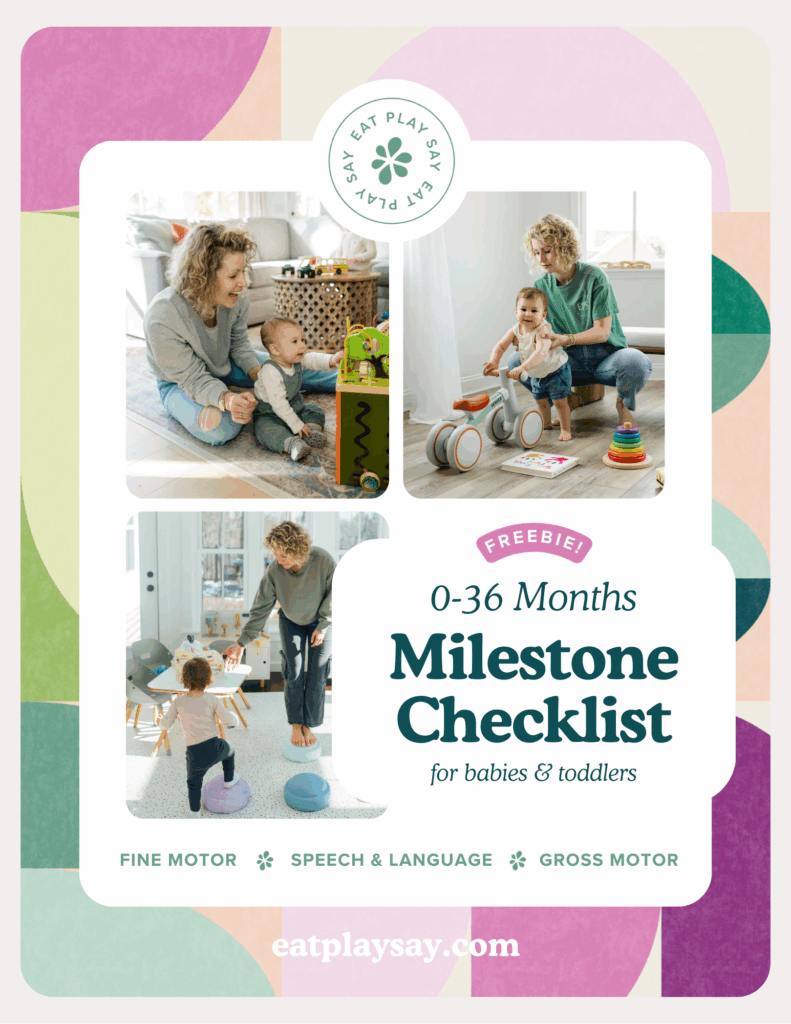
These are just some of the expected milestones for 3 year olds. You’re probably wondering how it’s possible that your brand new baby is almost ready for preschool. To check and see where your toddler might need extra support as they transition into this era, download our free Milestone Checklist!
Developmental activities for 3 year olds
The best developmental activities for 3 year olds give them the freedom to make decisions and use their imaginations. Toys that can be used in multiple ways or provide opportunities for pretend play are perfect for this age!
Here are our top 5 activities for 3 year olds:
Building with Magnatiles! There are hundreds of magnetic tiles to choose from, but we love these and also this insanely fun race car track. Magnetic tiles provide endless opportunities for toddlers to creatively build structures and incorporate other playscapes alongside them. Building a castle for Barbie? Yes you are! A cake for dessert? Also yes.
Balancing practice. Outdoor ride-on toys like a scooter or balance bike are perfect for 3 year olds. In addition to being loads of fun, outdoor toys like these promote gross motor development. Practice following directions like “stop!” and “go!” while they explore. Plus, activities like these burn lots of energy!
Pretend play all day! Whether your little one wants to play with a classic dollhouse or spend the afternoon playing veterinarian, now is the time to support this imaginative play any chance you get! You can find more of our pretend play favorites here. You don’t need fancy toys or expensive play sets though. Toddlers can create whole worlds with things you already have at home!
Arts & crafts time. With milestones like drawing, writing, and using scissors in your midst, arts and crafts are more useful than ever! We did the research on the best toddler craft supplies so you don’t have to! Our favorite supplies for practicing using scissors can be found here. No matter what you have on hand, you can’t go wrong with exposing your toddler to these skills.
Books and more books! Reading with your toddler is hands down one of the best activities to support your child’s growth! Speech-language pathologist and mom approved. You can find our favorite books for 3 year olds here. You can also start transitioning to books that are a little longer. These books have a story line and support early literacy, rhyming, and letter recognition!
Sensory activities for 3 year olds
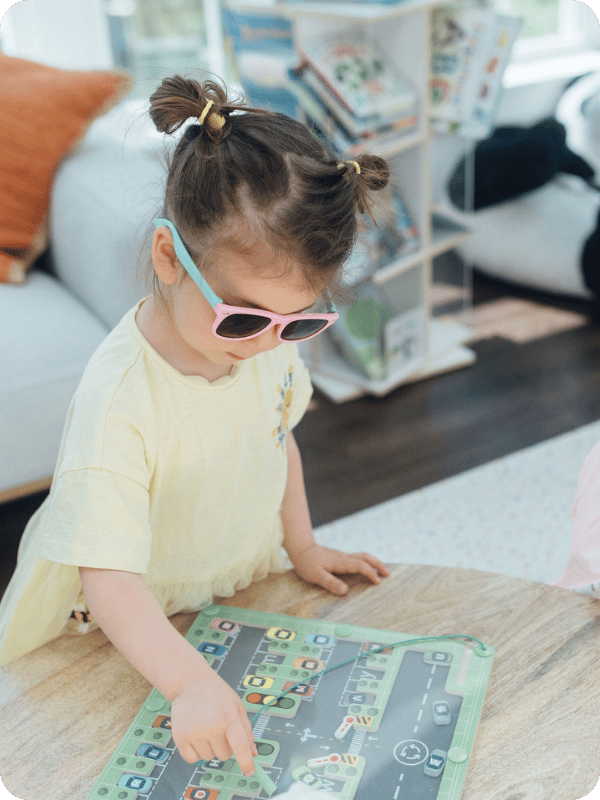
As your little one’s independent streak blossoms, sensory play becomes a lot more imaginative. A mud puddle becomes the starting point for an outdoor play kitchen recipe. Musical instruments are accompanied by their own unique lyrics! Sensory bins continue to be a hit at this age, too. The possibilities are endless.
A few of our favorite sensory activities for 3 year olds are:
- Practice kitchen skills together by having your little one help you prepare for snack time! Have them cut soft foods, like a banana or a kiwi, with a child-safe toddler knife. A plastic butter knife also works! If you aren’t ready to move onto real foods yet, this activity works well with Play-Doh too.
- Practice counting in nature with your toddler. Counting is a new skill for three year olds, so mixing it into play time is a great, low-pressure way to work on it! Head outside for a walk around your yard or a park. Have your little one “find two leaves” or help you “find one rock.” For an added speech-language bonus, label aloud where they found the items to prompt them to use prepositions and location vocabulary!
Crafts for 3 year olds
By three, arts & crafts reach the point where little ones can do most of the steps with a little support. Game. Changer. At Eat Play Say, we specialize in crafts that take less than 10 minutes and don’t use a ton of fancy supplies. Rest assured that these crafts won’t ruin your day.
Some excellent crafts to do with your 3 year old are:
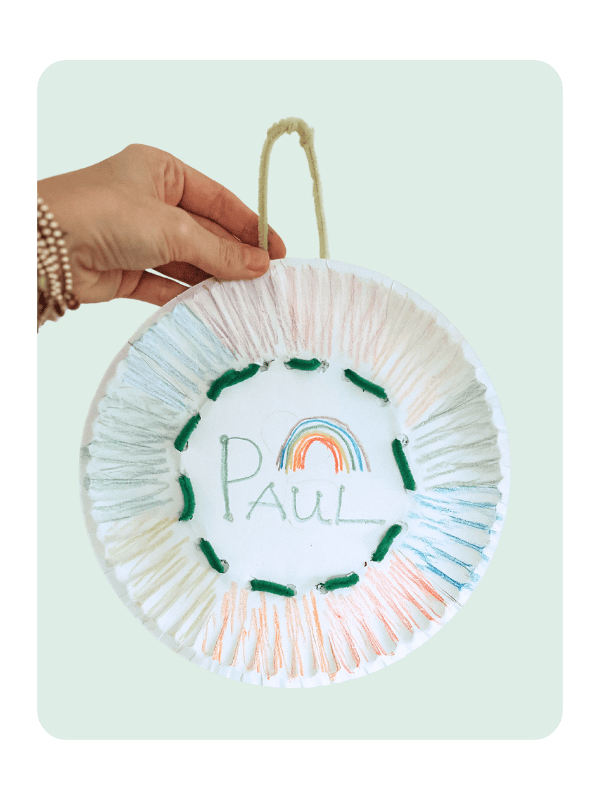
Rainbow weaver
Supplies needed: paper plate, green pipe cleaners, crayons or markers
Time to complete: 10 minutes
Fine motor skills it supports: sensory exploration, fine motor strength and coordination
Directions:
- Poke holes in a circle in your paper plate. Use a hole punch or a pencil tip/screwdriver to poke the holes. This will be for weaving the pipe cleaner.
- Let your little one color all over the paper plate.
- When done, let them weave the pipe cleaner through the holes. Three year olds will be more independent, while younger ones will need help. For babies, pull the pipe cleaner through the hole slightly and let them reach and grab it the rest of the way through!
- Weave all the way around (we used 2 pipe cleaners) and attach a pipe cleaner to the back as a hanger.
- Let your little one practice tracing their name if you want!
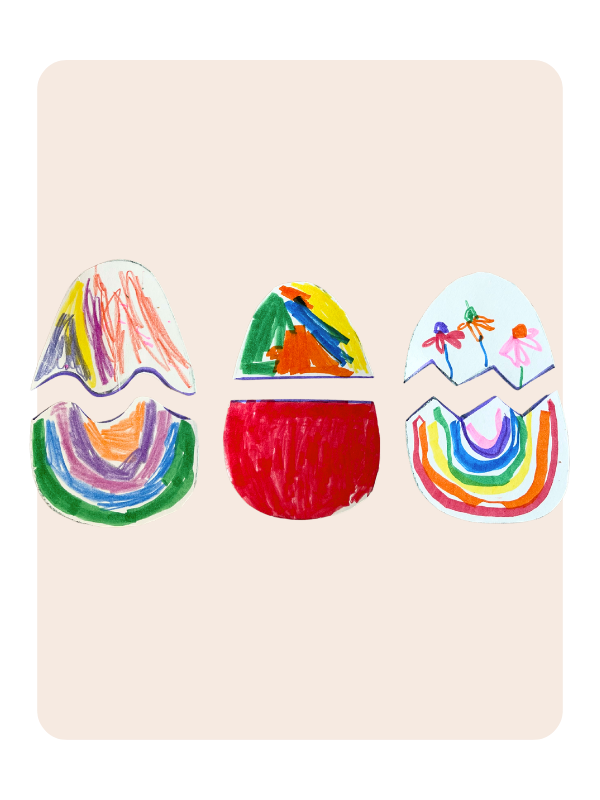
Puzzle eggs
Supplies needed: paper plate or construction paper, crayons/markers, scissors.
Time to complete: 10 minutes
Fine motor skills it supports: bilateral coordination, fine motor manipulation and coordination, hand strengthening, pincer grasp, scissor skills.
Directions:
- To prep this craft, use a marker/crayon to draw an egg shape on the back of 3 different paper plates or construction paper. Cut the eggs out. For littles 2.5 years and up, let them help you cut out the eggs!
- Let your little one decorate the egg pieces with crayons/markers.
- Grab a black marker and draw 3 different lines in the middle of each egg: a wavy line, a straight line, and a zig-zag line.
- Cut on the lines you made. Have your toddler help! Cutting is a great skill to practice for 3 years +!
- Play a game! Take turns hiding one half of the egg and help your little find the matching piece. Model how these eggs go together like a puzzle!
Gross motor activities for 3 year olds
Coordination skills are really being refined throughout the third year. It may seem like small changes, such as jumping over an obstacle, but these skills are vital to your little one’s development!
Some of the best gross motor activities for three year olds are:
- Practice kicking with your toddler by gently tossing a balloon toward their feet. Balloons move slowly enough to allow your toddler time to prepare to kick. Plus, no matter how hard they kick it, a balloon won’t fly through the kitchen window! Then, when you’re outside, try it out with a real ball!
- Catching and throwing skills develop a lot this year! Grab a bean bag or a small/medium soft ball. Stand a few steps away from your toddler and gently toss it to them underhand. If they catch it, take another step back. Stay in place if they drop it and try again! See how far apart you can get while tossing back and forth!
Fine motor activities for 3 year olds
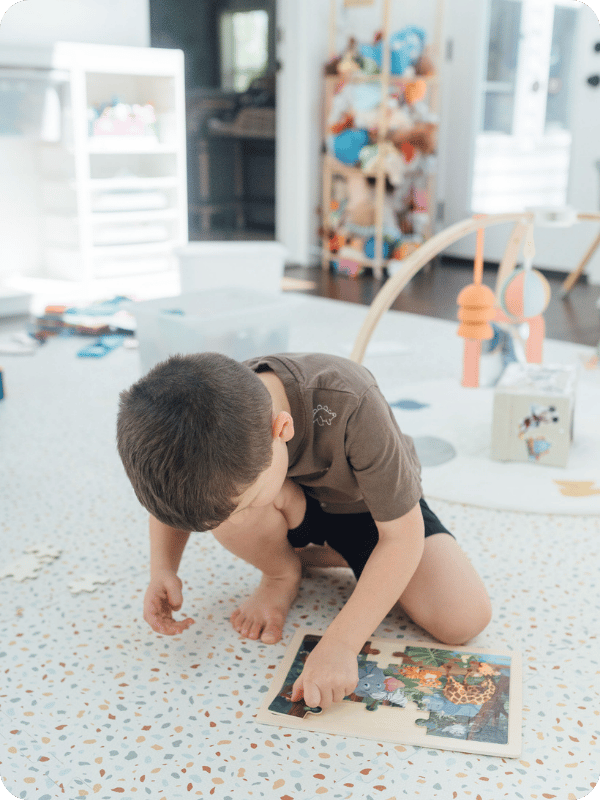
There are countless activities you can do with your 3 year old to help them develop their fine motor skills. Everyday tasks involve a lot of fine motor activity. For a little extra focus on these skills, incorporate games and activities that involve tasks like drawing, cutting, pouring, and copying after you.
A few of our top fine motor activities for 3 year olds are:
- Draw a house with your toddler. The shape of a house is perfect to practice drawing horizontal, vertical, diagonal, and perpendicular lines! Model drawing each line for your little one, then wait for them to copy you. Practice coloring inside the lines when you’re finished drawing. It’s not going to look perfect, and that’s okay!
- Work on copying skills by taking 3 blocks and arranging them in different forms. Try stacking a tower, lining them up in a row, etc. Model an arrangement, then ask your little one to copy it by building one exactly the same. You can do this with canned goods or anything else your toddler is interested in. Make little houses for dolls, trains, cars, or anything else “pretend” out of these blocks!
Need more play ideas?
Every day is a marathon with a high-energy three year old, and you’re doing the thing! You should pat yourself on the back.
For more play time support, check out our resources like the 52 Play Themes freebie. And if you need more ideas for simple, fun activities, check out our toddler activities at home blog!
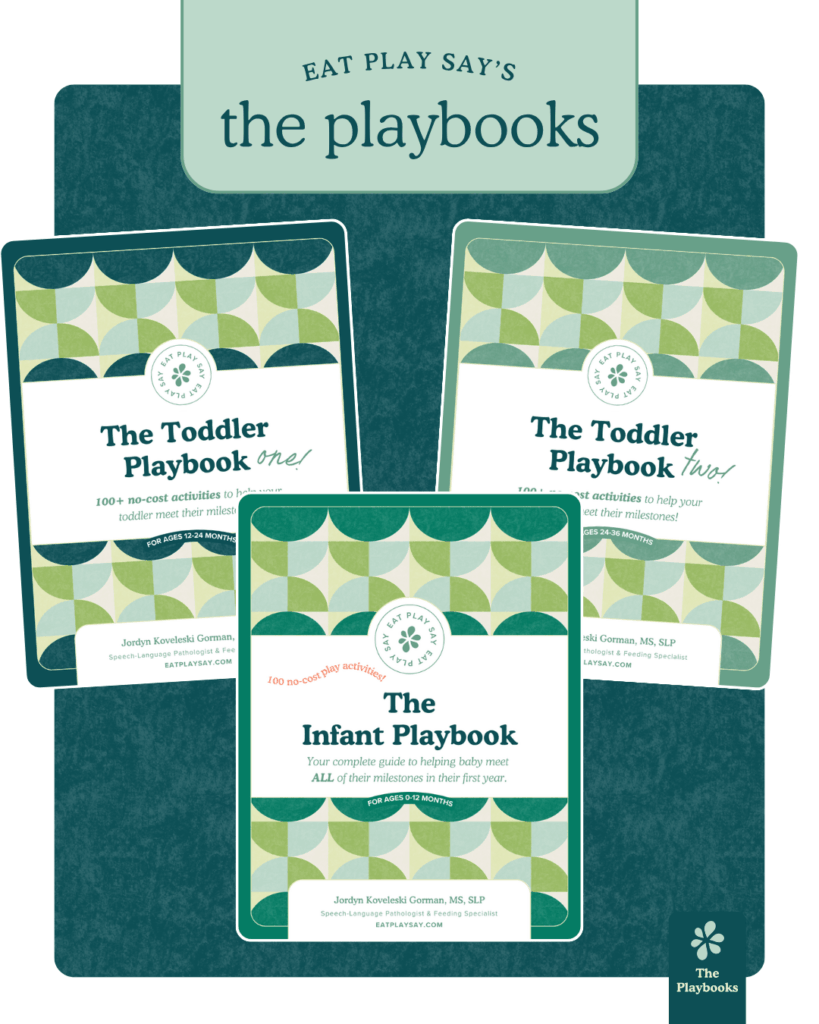
Looking for more support for 0-3 years of age? For 100+ play ideas using only what you have at home, check out our Playbooks!
Sources
- Center on the Developing Child at Harvard University (2011). Building the Brain’s “Air Traffic Control” System: How Early Experiences Shape the Development of Executive Function: Working Paper No. 11.
- Michael Yogman, Andrew Garner, Jeffrey Hutchinson, Kathy Hirsh-Pasek, Roberta Michnick Golinkoff, COMMITTEE ON PSYCHOSOCIAL ASPECTS OF CHILD AND FAMILY HEALTH, COUNCIL ON COMMUNICATIONS AND MEDIA; The Power of Play: A Pediatric Role in Enhancing Development in Young Children. Pediatrics September 2018; 142 (3): e20182058. 10.1542/peds.2018-2058
Leave a Reply
OTHER POSTS YOU MAY LIKE:



MS, SLP
Founder of Eat Play Say, Speech-Language Pathologist, Feeding Specialist, Play Expert, Mom of 3
Jordyn Koveleski Gorman
SPECIALIZES IN: Infant and toddler speech-language, play, and feeding development, and curating a team that provides expert help that feels like a reassuring text from that one mom friend
EDUCATION: Jordyn received her BS in Speech-Language Pathology from Bloomsburg University and her MS in Speech-Language Pathology from Towson University
FAVE PARENTING FIRST: “The first true smile, it’s the sweetest!”

MS, CCC-SLP, CBS, IBCLC
Speech-Language Pathologist & Feeding Specialist, Certified Breastfeeding Specialist, International Board Certified Lactation Consultant
Jessica Nicholson Cocca
SPECIALIZES IN: Breast and bottle feeding, tongue ties, oral motor dysfunction, starting solids, infant and toddler speech, treating oral motor disorders
EDUCATION: Jessica received her BS in Communication Sciences and Disorders from Pennsylvania State University in 2015 and her MS in Speech-Language Pathology from Towson University in 2017
FAVE PARENTING FIRST: “Baby’s first wave! What a fun first communication gesture!”

MA, CCC-SLP, CLC
Speech-Language Pathologist, Certified Lactation Counselor
Jennifer McFarlin
SPECIALIZES IN: Breast and bottle feeding, tongue ties, starting solids, infant and toddler speech development
EDUCATION: She received her BS in Speech-Language Pathology from Ball State in 2014 and a MA in Speech-Language Pathology from Ball State in 2016.
FAVE PARENTING FIRST: “My favorite baby’s first is their first true smile that just warms your soul knowing they are smiling at you. My other favorite is their first word. I love watching their language explode!”

MS, CCC-SLP
Bilingual Speech-Language Pathologist
Nicole La Petina Kelly
SPECIALIZES IN: Bilingual development (Spanish-English), supporting multilingual families, infant and toddler speech
EDUCATION: She received her BA in Communication Sciences and Disorders and in Spanish from the University of Wisconsin-Madison in 2014 and her MS in Speech-Language Pathology with an English-Spanish Specialization from Marquette University in 2016.
FAVE PARENTING FIRST: “It’s the first slobbery kisses for me!”

RDN, LD
Licensed Registered Dietitian
Kimberly Vede
SPECIALIZES IN: Infant and pediatric nutrition including breastfeeding, formula feeding, and starting solids. She also specializes in prenatal and postpartum nutrition.
EDUCATION: She received her BSc in Biology in 2014 from Life University, and her BSc in Dietetics from Life University in 2019.
FAVE PARENTING FIRST: ”The first time they say ‘mama!’”


This checklist was created with input from a Speech-Language Pathologist, Occupational Therapist and Physical Therapist and has been downloaded over 20,000 times by parents worldwide. Learn the important milestones to pay attention to, and keep it in your digital back pocket during the baby + toddler years!
Comprehensive Milestone Checklist for gross motor, fine motor, and speech-language milestones for 0-36 months,
DOWNLOAD FOR FREE


