


Activities for 18 Month Olds
January 15, 2025
Jordyn Koveleski Gorman

Last Updated on February 4, 2026 by Jordyn Koveleski Gorman
This page contains affiliate links. We will receive a commission on qualifying purchases using these links.
By 18 months old, your child is starting to really understand play routines and is mostly moving independently. They’re also starting to communicate basic wants and needs with more and more confidence. This has been one of my favorite ages with my own kids.
At this point, you’ve already set an amazing foundation for your little one to flourish. Supporting them through milestone development gets a lot simpler, building off of work you’ve already done! Development may look like it slows down now that your little one can eat, crawl, walk, and maybe even run. But inside, your toddler’s brain is changing rapidly.
In fact, research has shown that even though impulse control doesn’t visibly progress much in early toddlerhood, internally young toddlers’ brains activate much faster and in more areas than in late infancy. (1)
The foundation matters, and it’s helping so much more than you can see! As a result, our favorite activities for 18 months olds focus on building upon your already sturdy foundation.

18 month milestones
Here are a few milestones that we expect to see at this age:
- Matches puzzle pieces
- Turns 2-3 pages of a thick board book
- Says 10-50 words independently, especially with a variety of sounds like “b, p, m, n, t, d”
- Speaks with ~25% intelligibility (meaning you can understand what your little one is saying about a quarter of the time or more!)
- Follows 2-step directions with models from you (e.g., “pick this up and put it in the trash, please!”)
- Points to identify common vocabulary (including body parts)
- Carries toys while walking
- Pushes and pulls toys while walking
By now, you’re probably finding that tracking milestones isn’t as overwhelming as when your baby was a newborn. But that doesn’t mean they’re any less important now! This tends to be the age where introducing new skills can be really fun. You might think it’s crazy that we recommend handing crayons to your 18 month old…but it’s developmentally normal, including the messes!
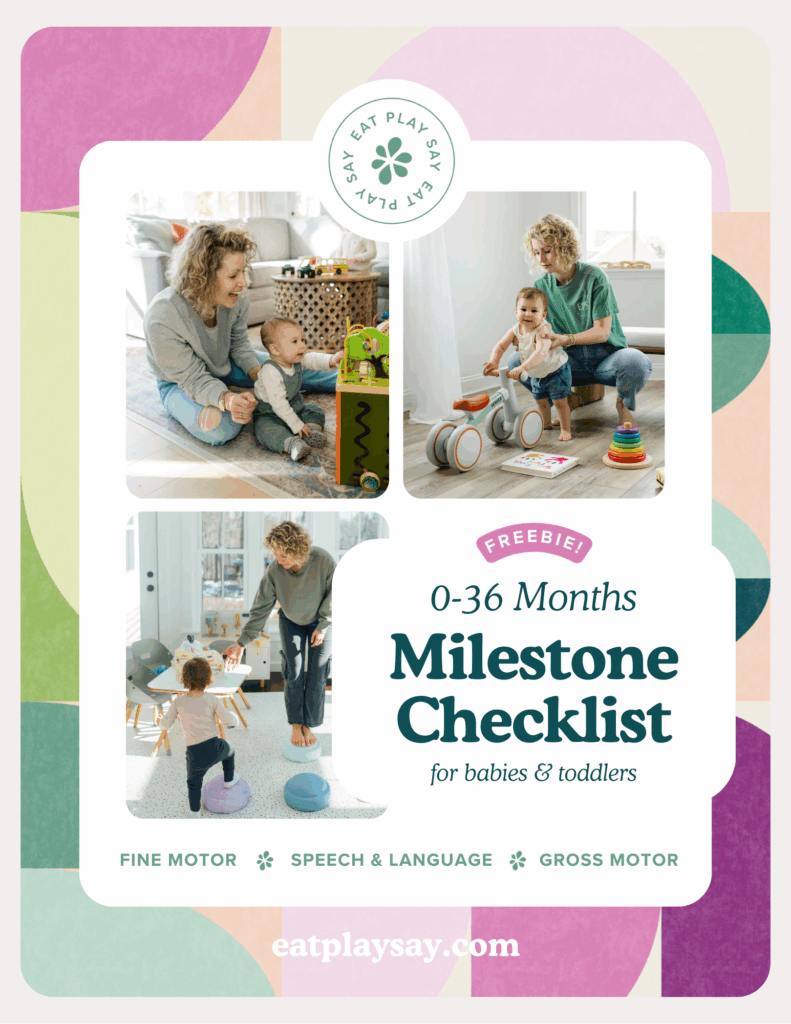
To check and see where your toddler might need extra support, download our comprehensive (free!) milestone checklist for 0–36 months!
Developmental activities for 18 month olds
With a toddler always on the go, it can be hard to wrangle them for focused playtime. That’s okay! Our favorite activities support their budding imaginations and let them get out all that energy!
Here are our top 5 activities for 18 month olds:
Tea time! A tea set is absolutely perfect for pretend play. Let your little one’s imagination take over while they explore. This is also a great way to indirectly practice following directions in a fun way. Our favorite tea set is super durable and cleans easily so you don’t have to worry about rough play.
Play sink! Hours of independently fun play…yes please! This particular sink actually has running water and comes with a variety of dishes including cups, utensils, and plates. Your little one can imitate what they have watched you do in the kitchen. It’s functional, educational, and occupies littles for extended play time! Pro tip: put a towel under the sink to soak up any spilled water. Set your little one up in the kitchen in a toddler tower and do the dishes together.
Mr. Potato Head! You might have thought Mr. Potato Head was a toy of the past, but it’s still the perfect toy for this age group! There are so many milestones that can be tied to just this single toy. It’s the perfect mix of play and learning body parts, as well as adding adjectives like “wiggly, big, bumpy” to the body parts. This is a really great toy to imitate 2 word phrases with nouns and actions (e.g., “eyes on” and “hat off”).
Movement play! Let your new toddler move about on a balance bike! These bikes can be used outside and inside. All your little one has to do is push with their feet and legs. This is a great activity to get some zoomies out and work on gross motor development.
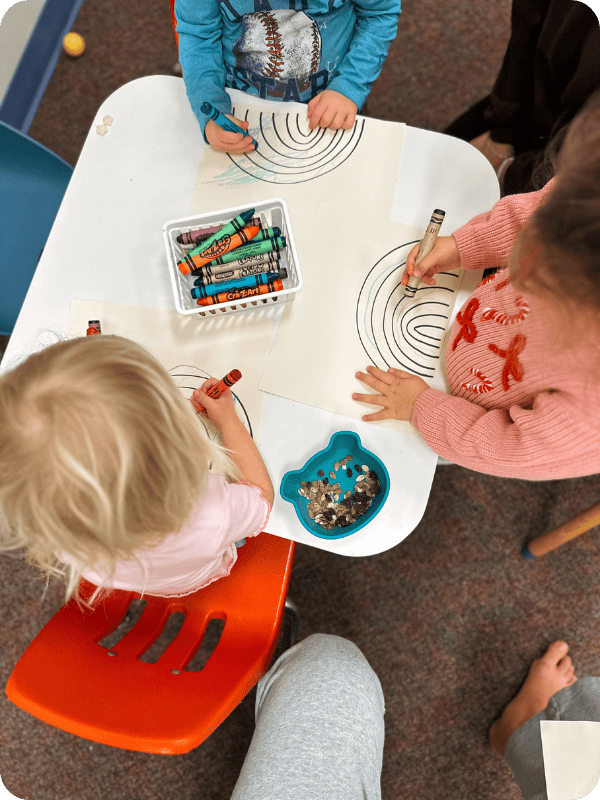
Crayons or chalk! When giving your little one some type of drawing utensil, there is no expectation. At this age, they don’t need to be coloring inside the lines or tracing any particular shape. Just allow their creative spirit to go, and model how to scribble and make lines. Try out these crayons and chalk—they’re chunky for your child to easily grip!
Sensory activities for 18 month olds
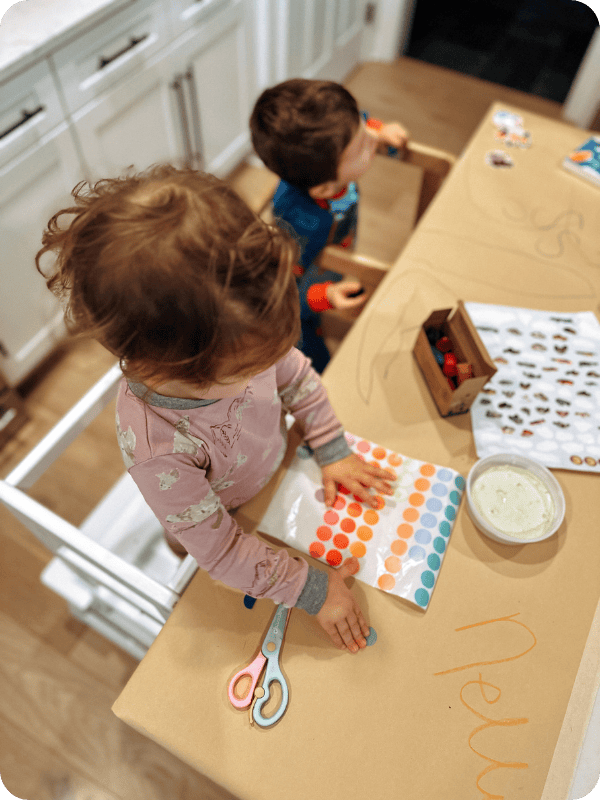
If you’re looking for a classic sensory activity in the form of a sensory bin, we’ve got you covered with an entire blog post of sensory bin ideas. We love sensory bins! To get all the senses working together, it’s great to incorporate other activities as well.
A few of our favorite sensory activities for 18 month olds are:
- Pretend to be different animals when going from room to room! Jump like a frog, slither like a snake, stomp like a dinosaur, or run like a cheetah. See how many different animals you can be! This is a great way to work on body coordination and get the jitters out, and a great speech-language activity took!
- Shaving cream in the bathtub is so much fun! You can use whipped cream for a taste-safe option, too. Spray the tub wall with the cream and have your little one help you spread it out to make a canvas. Have them practice using their pointer finger to make marks and scribbles! You can model starting at the top to make one straight line and see if they try to imitate you. It’s okay if the line isn’t perfect!
Crafts for 18 month olds
As your child settles into toddlerhood, the world of crafting opens up wide! We love our craft station, and our favorite craft supplies are always on rotation.
Some of the best crafts to do with your 18 month old include:
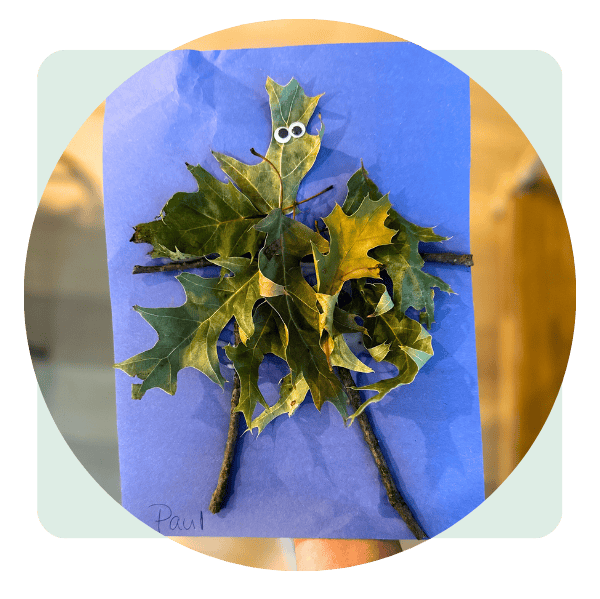
Silly leaf person
Supplies needed: leaves, twigs, googly eyes, glue stick, construction paper
Time to complete: 10 mins prep, 10 mins craft
Ages appropriate: 15+ months
Fine motor skills it supports: pincer grasp, hand-eye coordination, writing utensil grasp (with glue stick)
- Get outside! Find some fun colored leaves (not too crunchy) and twigs.
- After gathering leaves, head inside and build your leaf person!
- Glue the leaves and twigs on construction paper, using the leaves as the “body” and the twigs as the “arms” and “legs.”
- Add those silly googly eyes on top! If your little one isn’t ready to use the glue stick, have them help you by pointing where they want to put the glue.

Paper garland
Supplies needed: construction paper, scissors, glue stick
Time to complete: 10 minutes
Ages appropriate: 18+ months
Fine motor skills it supports: cutting (older toddlers), drawing lines (2+ year olds), writing utensil grasp, bilateral coordination
- Remember these from grade school?! Grab some fun colored construction paper and cut a bunch of paper strips to get this craft ready.
- Let your little one help you glue the ends of the strip together to make a circle.
- Work on lacing skills as your little one weaves the next strip of paper through the first circle to create the chain.
- Continue weaving and gluing the strips into circles until you have a lovely colored garland! Hang it over a doorway or your mantel for a fun decoration at any time of year, or use it as a countdown for something exciting that’s coming soon!
Gross motor activities for 18 month olds
Toddlers are fast, and they’re always changing directions. Encouraging gross motor development is pretty easy at this age, since almost all of their energy seems to be devoted toward wiggling and giggling.
A few of our top gross motor development activities for 18 month olds are:
- Grab a ball and head outside for some fun. Have your little one try to throw the ball as far as they can, then have a race to see who can get it first. Your little one will start by trying to throw overhand, but will eventually transition to underhand tossing. If they need a little help, model throwing the ball both ways for them. It’s going to look pretty uncoordinated at first. Don’t worry about their feet; they’ll get better soon!
- Play a game of balloon ball! Blow up some latex balloons to lightly tap/toss to your little one. Balloons move nice and slow, giving your toddler time to stretch out their arms to try to catch it. Make sure to only use balloons when supervised, since popped balloons can quickly become choking hazards.
Fine motor activities for 18 month olds
Fine motor skills are showing up everywhere, from sensory exploration to arts & crafts. You can never go wrong with helping your child develop their fine motor skills, which will soon turn into new abilities like cutting with scissors! (Don’t panic, you’ve still got a few months before then!)
Our favorite fine motor activities for 18 month olds are:
- Zipper practice! Grab a few of your little one’s jackets/coats and put them on your pillows, making little pillow people! Have your little one practice zipping and unzipping the jackets to put them on/take them off the pillows. It’s easier to zip/unzip someone else’s coat, so this activity helps build confidence to work on their own!
- Grab some markers or crayons and an empty Amazon box, and get to scribbling! Help your little one scribble on all the sides of the box. Practice drawing lines by starting at the top of the box and drawing all the way down to the bottom. Say “down” as you draw, then pause to see if your toddler tries to do it too! Drawing on a vertical surface increases wrist strength and coordination needed for writing skills.
Need more play ideas?
The best advice for keeping an 18 month old engaged and learning? Bring them along for daily tasks! To grown ups, doing laundry or getting the mail is just another boring chore. But to a 1.5 year old? It’s the most exhilarating 10 minutes of the day!
Building language skills is a huge priority for parents at this age, so remember: language is everywhere. Model for your child what you’re doing by narrating day-to-day tasks while you do them together. Use simple phrases whenever possible, naturally carrying on a chat even when you don’t have a clue what your child is babbling about.
You’re rocking parenthood!
Looking for more support? For 100+ play ideas using only what you have at home, check out our Playbooks!
Sources
- Abigail Fiske, Liam Collins-Jones, Carina de Klerk, Katie Y.K. Lui, Alexandra Hendry, Isobel Greenhalgh, Anna Hall, Henrik Dvergsdal, Gaia Scerif, Karla Holmboe; The neural correlates of response inhibition across the transition from infancy to toddlerhood: An fNIRS study. Imaging Neuroscience 2024; 2 imag–2–00206. doi: https://doi.org/10.1162/imag_a_00206
OTHER POSTS YOU MAY LIKE:



MS, SLP
Founder of Eat Play Say, Speech-Language Pathologist, Feeding Specialist, Play Expert, Mom of 2
Jordyn Koveleski Gorman
SPECIALIZES IN: Infant and toddler speech-language, play, and feeding development, and curating a team that provides expert help that feels like a reassuring text from that one mom friend
EDUCATION: Jordyn received her BS in Speech-Language Pathology from Bloomsburg University and her MS in Speech-Language Pathology from Towson University
FAVE PARENTING FIRST: “The first true smile, it’s the sweetest!”

MS, CCC-SLP, CBS, IBCLC
Speech-Language Pathologist & Feeding Specialist, Certified Breastfeeding Specialist, International Board Certified Lactation Consultant
Jessica Nicholson Cocca
SPECIALIZES IN: Breast and bottle feeding, tongue ties, oral motor dysfunction, starting solids, infant and toddler speech, treating oral motor disorders
EDUCATION: Jessica received her BS in Communication Sciences and Disorders from Pennsylvania State University in 2015 and her MS in Speech-Language Pathology from Towson University in 2017
FAVE PARENTING FIRST: “Baby’s first wave! What a fun first communication gesture!”

MA, CCC-SLP, CLC
Speech-Language Pathologist, Certified Lactation Counselor
Jennifer McFarlin
SPECIALIZES IN: Breast and bottle feeding, tongue ties, starting solids, infant and toddler speech development
EDUCATION: She received her BS in Speech-Language Pathology from Ball State in 2014 and a MA in Speech-Language Pathology from Ball State in 2016.
FAVE PARENTING FIRST: “My favorite baby’s first is their first true smile that just warms your soul knowing they are smiling at you. My other favorite is their first word. I love watching their language explode!”

MS, CCC-SLP
Bilingual Speech-Language Pathologist
Nicole La Petina Kelly
SPECIALIZES IN: Bilingual development (Spanish-English), supporting multilingual families, infant and toddler speech
EDUCATION: She received her BA in Communication Sciences and Disorders and in Spanish from the University of Wisconsin-Madison in 2014 and her MS in Speech-Language Pathology with an English-Spanish Specialization from Marquette University in 2016.
FAVE PARENTING FIRST: “It’s the first slobbery kisses for me!”

RDN, LD
Licensed Registered Dietitian
Kimberly Vede
SPECIALIZES IN: Infant and pediatric nutrition including breastfeeding, formula feeding, and starting solids. She also specializes in prenatal and postpartum nutrition.
EDUCATION: She received her BSc in Biology in 2014 from Life University, and her BSc in Dietetics from Life University in 2019.
FAVE PARENTING FIRST: ”The first time they say ‘mama!’”


This checklist was created with input from a Speech-Language Pathologist, Occupational Therapist and Physical Therapist and has been downloaded over 20,000 times by parents worldwide. Learn the important milestones to pay attention to, and keep it in your digital back pocket during the baby + toddler years!
Comprehensive Milestone Checklist for gross motor, fine motor, and speech-language milestones for 0-36 months,
DOWNLOAD FOR FREE


